The College Library now subscribes to DynaMed Plus, the updated version of DynaMed. Like its predecessor, DynaMed Plus is a point-of-care resource providing current disease guidance and recommendations for treating and managing patients. It contains more than 3200 topic summaries created by physicians and evaluated by an editorial team for clinical relevance and scientific validity. Topic summaries are updated daily based on a review of the scientific literature.
What profession might you have pursued, if not medicine?
I was in the clinical psychology program at McGill before medical school.
Which talent would you most like to have?
The ability to heal 100% of the time. I think every doctor wants that.
What do you consider your greatest achievement?
Writing for the popular media has become a passion. It gives me a platform to raise awareness for women’s health and battle the stigma of infertility.
Victoria Best Babies is a pre- and postnatal nutrition program that provides support to improve the health and well-being of pregnant women, new mothers, and babies facing challenging life circumstances. The program aims to improve maternal–infant health, increase the rates of healthy birth weights, and promote and support breastfeeding. The program also aims to promote the creation of partnerships in communities and strengthen community capacity to increase support for vulnerable pregnant women and new mothers.
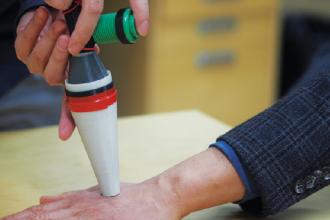
Work is being done on a simple compact laser probe that can distinguish between harmless moles and cancerous ones in a matter of seconds. Daniel Louie, a PhD student, constructed the device as part of his studies in biomedical engineering at the University of British Columbia. The probe works on the principle that light waves change as they pass through objects. Researchers aimed a laser into 69 lesions from 47 volunteer patients at the Vancouver General Hospital Skin Care Centre and studied the changes that occurred to this light beam. Because cancer cells are denser, larger, and more irregularly shaped than normal cells, they caused distinctive scattering in the light waves as they passed through. Researchers were able to invent a novel way to interpret the patterns instantaneously. This optical probe can extract measurements without needing expensive lenses or cameras, and it can provide a more easily interpreted numerical result like those of a thermometer. Although the components of the probe cost only a few hundred dollars, it is not envisioned to be a consumer product. Tim Lee, an associate professor of skin science and dermatology at UBC and a senior scientist at both BC Cancer and the Vancouver Coastal Health Research Institute, supervised the work. He believes the device would be a good future addition to standard cancer screening methods, but not a replacement.