EcoLens: Capturing climate change through community storytelling in BC
Issue: BCMJ,
vol. 68, No. 4, May 2026,
Pages 146-147 BC Centre for Disease Control
Increasingly, climate change is shaping the health and well-being of British Columbians in visible and personal ways. Public health surveillance systems track health impacts from environmental hazards such as extreme heat and wildfire smoke, but they cannot fully reflect the lived realities of people navigating these events. To address this gap, the BC Centre for Disease Control created EcoLens, an online storytelling platform where people can upload and explore climate stories through an interactive map or themed collections.
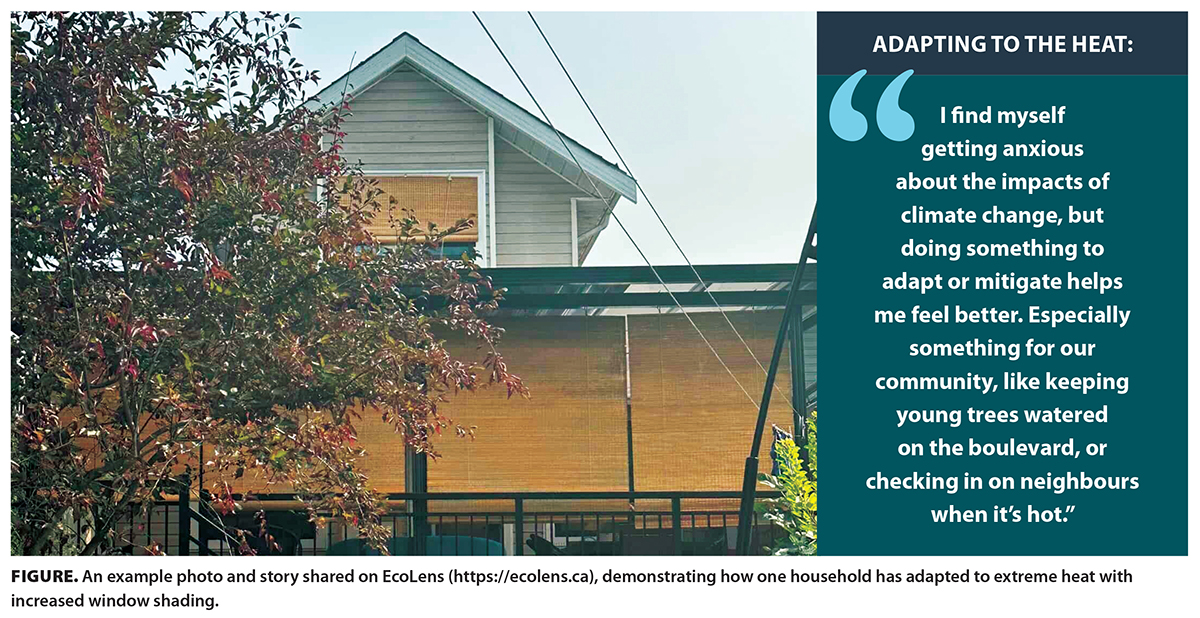
EcoLens is a provincial initiative that invites people to share photos and short reflections about how climate change is affecting their lives and their health [Figure]. The platform brings community-generated place-based knowledge into the broader conversation about climate change impacts and resilience. This approach builds on existing qualitative and participatory research methods, including photovoice, which uses images and narrative to support reflection and learning.[1]
Why stories matter for climate change and health
The impacts of climate change are not distributed equally throughout BC. For example, rural and remote areas, Indigenous communities, people experiencing homelessness, and isolated seniors often face greater risks.[2] Communities also differ in how they respond to the impacts, and the differences are not always captured in administrative data. EcoLens brings deeper dimensions of susceptibility and resilience to light through lived experiences, offering insight that can help health professionals better understand and respond to local needs.
Climate anxiety is increasingly recognized as a mental health issue in Canada.[3] Research shows that climate anxiety often stems from feeling alone, powerless, or overwhelmed by abstract global threats.[4] EcoLens provides a space where people can document local impacts and personal actions, humanizing climate change as a shared social experience rather than something distant or abstract. Storytelling helps people process emotions, build collective efficacy, and regain a sense of control in the face of uncertainty.
Turning collective experience into collective evidence
As the story collection grows, we hope that EcoLens will support public health practice in several ways. Thematic insights may improve climate adaptation planning and community engagement strategies. Emerging observations can generate new research questions and catalyze future research initiatives. Lessons learned from the platform may also inform knowledge translation products and educational materials tailored to diverse audiences. Over time, EcoLens can help support more responsive and equitable decision making.
EcoLens is ultimately about connection—connecting health professionals with lived experiences, connecting communities with one another, and connecting individual stories to broader patterns of resilience. In a time of rising climate anxiety, EcoLens offers a space for learning, reflection, and solidarity.
Call to action
As EcoLens grows, physicians have an important role to play in strengthening its reach and impact. Clinicians are often the first to hear about how climate-related events affect their patients’ health and safety. By sharing the platform, physicians can help ensure that the stories collected reflect the geographic and cultural diversity of the province.
To get involved or to learn how EcoLens can support your work, contact us at ecolens@bccdc.ca.
—Adam Cassady, MPPGA
Project Manager, Environmental Health Services, BCCDC
—Breann Corcoran, MSc
Environmental Health and Knowledge Translation Scientist, Environmental Health Services, BCCDC
—Angela Yao, PhD
Senior Scientist, Environmental Health Services, BCCDC
—Sarah B. Henderson, PhD
Scientific Director, Environmental Health Services, BCCDC
hidden
This article is the opinion of the BC Centre for Disease Control and has not been peer reviewed by the BCMJ Editorial Board.

This work is licensed under a Creative Commons Attribution-NonCommercial-NoDerivatives 4.0 International License.
References
1. Spiegel SJ, Thomas S, O’Neill K, et al. Visual storytelling, intergenerational environmental justice and Indigenous sovereignty: Exploring images and stories amid a contested oil pipeline project. Int J Environ Res Public Health 2020;17:2362. https://doi.org/10.3390/ijerph17072362.
2. Health Canada. Health of Canadians in a changing climate: Advancing our knowledge for action. February 2022. Accessed 13 March 2026. https://publications.gc.ca/collections/collection_2022/sc-hc/H129-121-2022-eng.pdf.
3. Harper SL, Cunsolo A, Aylward B, et al. Prevalence, magnitude and distribution of climate change anxiety in Canada: An interdisciplinary study. Nat Ment Health 2025;3:1384-1394. https://doi.org/10.1038/s44220-025-00521-4.
4. Hajek A, König H‑H. Climate anxiety, loneliness and perceived social isolation. Int J Environ Res Public Health 2022;19:14991. https://doi.org/10.3390/ijerph192214991.