
Pancreas screening in high-risk individuals
Issue: BCMJ,
vol. 68, No. 9, November 2026
|
Pages 313-319 |
Review Articles
ABSTRACT: Pancreas screening is recommended for individuals who are at higher risk of developing pancreatic cancer due to family history or a documented germline pathogenic variant predisposing them. Screening entails annual imaging of the pancreas and screening for diabetes mellitus. The goals of screening are to identify high-risk precursor lesions and early-stage pancreatic cancer that is amenable to surgical resection, thereby reducing deaths due to pancreatic cancer. Pancreas screening is limited by the ability of current imaging technology to accurately distinguish low- and high-risk precursor lesions. Research is underway to develop a serum test for pancreas screening.
Pancreas screening of high-risk individuals has the potential to save lives, but the ideal screening strategy is not currently fully realized.
Key points
Assessment and management of individuals at risk for pancreatic cancer:
- Assess family history.
- Modify risk factors.
- Discuss the benefits, harms, and limitations of screening.
- Screen for diabetes.
- Refer to the BC Cancer Hereditary Cancer Program.
- Refer to an endoscopic ultrasound centre.
Most pancreatic cancer is pancreatic ductal adenocarcinoma (PDAC). Although PDAC has the 10th-highest incidence rate in BC, it is the 3rd-leading cause of cancer-related mortality, after lung and colorectal cancers,[1] and the 5-year survival rate is 10%.[2]
Screening for PDAC has been evaluated by the United States Preventive Services Task Force, with an evidence review of the potential benefits and harms of pancreas screening. The task force recommended against screening average-risk individuals.[3] However, individuals at increased risk of PDAC due to family history and/or a documented germline pathogenic variant or a likely pathogenic variant in an established PDAC susceptibility gene are recommended to consider pancreas screening.[4-9] Cancer susceptibility genes that confer moderate to high PDAC risk through rare pathogenic variants include ATM, BRCA1, BRCA2, CDKN2A, MLH1, MSH2, MSH6, PMS2, EPCAM, PALB2, STK11, and TP53, as well as several genes associated with hereditary pancreatitis.[10] Although efforts are underway to develop polygenic risk scores based on common genetic factors associated with PDAC susceptibility, they are not currently in clinical use.[11]
Other important risk factors for PDAC include smoking, alcohol use, obesity, chronic pancreatitis, and new-onset diabetes mellitus.[12] Individuals over 50 years of age who have had a diagnosis of diabetes in the last 3 years have a 7.9-fold increased risk of pancreatic cancer.[13] Similarly, obesity, defined as a BMI of 30 or higher, is associated with a 1.19-fold increased risk per unit increase in BMI, and alcohol use is considered to have a dose-dependent risk association exclusively in men, with heavy alcohol consumption (≥ 35 units/week) and a history of binge drinking (≥ 35 units/week, > 1 month) conferring a 2.6-fold and 3.5-fold increased risk of pancreatic cancer, respectively.[14,15]
Pancreatic neuroendocrine tumors are a less common type of pancreatic cancer and are discussed in detail by Sanders and colleagues in another article in this issue of the BCMJ. Several hereditary cancer syndromes are known to increase the risk of pancreatic neuroendocrine tumors. Although most are sporadic, 10% to 20% occur in the setting of an inherited syndrome, including multiple endocrine neoplasia type 1 and von Hippel-Lindau disease. Multiple endocrine neoplasia type 1 is an inherited predisposition to neoplasms of the parathyroid gland, pituitary gland, thymus gland, and lung, and to pancreatic neuroendocrine tumors. Patients with multiple endocrine neoplasia type 1 are offered pancreatic cancer screening starting between 8 and 15 years of age, with MRI or endoscopic ultrasound every 1 to 3 years.[16]
Who to screen
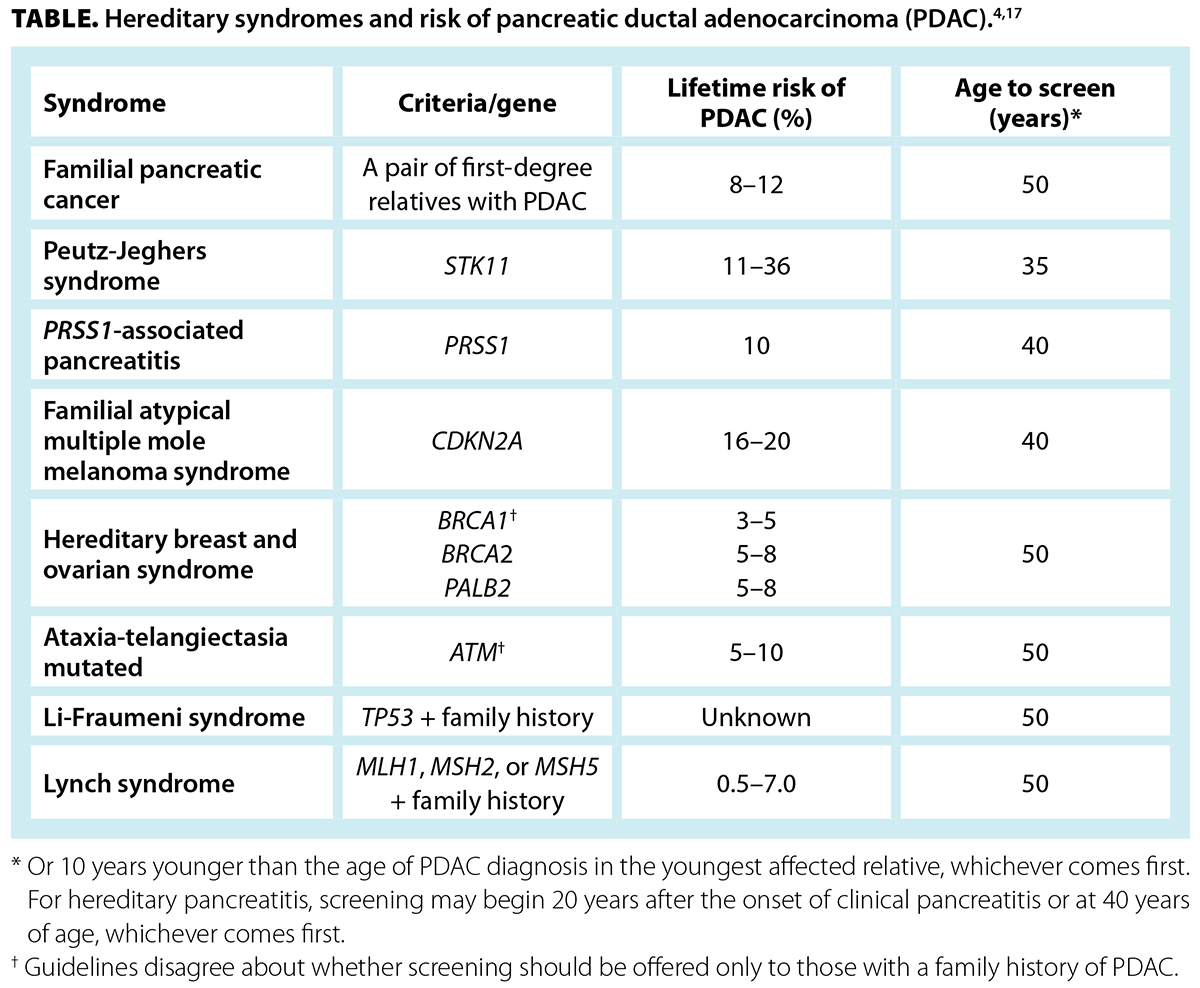
Eligibility criteria for pancreatic cancer screening vary slightly between guidelines.[4-8] Because the risk of pancreatic cancer varies across genes and family history of pancreatic cancer is both an independent and an additive risk factor, current screening guidelines reflect this complexity by varying recommendations according to the underlying gene and, for some genes, the presence or absence of a family history of pancreatic cancer [Table]. Screening generally commences at 50 years of age. Individuals with familial atypical multiple mole and melanoma syndrome or hereditary pancreatitis are recommended to begin pancreas screening at 40 years of age, while those with Peutz-Jeghers syndrome are recommended to begin screening at 35 years of age. For individuals with family members diagnosed with PDAC at younger ages, screening begins when the individual is 10 years younger than the age of diagnosis of the youngest affected family member.
Familial pancreatic cancer
Familial pancreatic cancer is defined as cancer that occurs in a pair of first-degree relatives (parent and child or two siblings) without a pathogenic variant in a pancreatic cancer susceptibility gene. Individuals who are a first-degree relative to one of the affected family members are eligible for screening. Familial pancreatic cancer yields an 8% to 12% lifetime risk of PDAC, while three or more first-degree relatives equates to a 40% lifetime risk.[17] Furthermore, an earlier age of familial pancreatic cancer diagnosis confers an increased risk of early-onset pancreatic cancer in high-risk individuals, which suggests a risk escalation based on age of onset.[18,19]
Hereditary pancreatic cancer
In addition to familial risk, documented pathogenic variants in pancreatic cancer susceptibility genes are an important risk factor for PDAC. The lifetime risk of PDAC varies depending on the affected gene [Table]. The risk is further increased by a family history of PDAC and varies depending on the number of relatives affected, the closeness of the relationship, and the age of diagnosis. Lifestyle and environmental factors further influence the risk.
The following syndromes are autosomal dominant hereditary cancer susceptibility syndromes in which inheriting one copy of the gene with a pathogenic variant is sufficient to significantly increase cancer risk, even if a normal second copy of the gene is also inherited. Once a patient is found to have a pathogenic variant, their parents, siblings, and children are at a 50% risk, and genetic counseling and testing are recommended.
Peutz-Jeghers syndrome
Peutz-Jeghers syndrome is caused by pathogenic variants in the STK11 gene. The syndrome is characterized by mucosal pigmentation in the mouth and perioral skin and pathologically distinct hamartomas throughout the gastrointestinal tract. Individuals with Peutz-Jeghers syndrome are at high risk of PDAC as well as cancers involving the gastrointestinal tract, breast, ovary, uterus, cervix, and testes.[6]
Familial atypical multiple mole and melanoma syndrome
Familial atypical multiple mole and melanoma syndrome is associated with pathogenic variants in the CDKN2A gene and presents with multiple moles and melanomas.
Hereditary breast and ovarian cancer syndrome
Pathogenic variants in the BRCA1, BRCA2, and PALB2 genes are associated with a high risk of breast, ovarian, pancreatic, and prostate cancer. Estimates range from 1 in 200 to 1 in 400 individuals that carry a pathogenic variant in the BRCA1 or BRCA2 gene, but there is a higher frequency in some populations.[20] In the Ashkenazi Jewish population, approximately 1 in 40 individuals are carriers,[21] which has prompted local awareness campaigns to inform individuals about genetic testing options, such as the BRCAinBC initiative.
Ataxia-telangiectasia syndrome
Individuals with a single pathogenic variant in ATM are at increased risk of PDAC, breast cancer, and prostate cancer and represent approximately 1/242 of the population.[22] In addition to the autosomal dominant risk of cancer, individuals with a pathogenic variant in both copies of the ATM gene are afflicted with ataxia-telangiectasia syndrome, characterized by a progressive neurodegenerative disorder, oculocutaneous telangiectasias, and immunodeficiency.
Li-Fraumeni syndrome
Li-Fraumeni syndrome is caused by a rare pathogenic variant in the TP53 gene. It is associated with a very high lifetime risk of cancer, often with early onset of disease, particularly breast cancer, sarcomas, brain tumors, and adrenocortical carcinoma, as well as several other malignancies, including pancreatic and prostate cancers.
Lynch syndrome
Lynch syndrome is another relatively common cancer predisposition. It is associated with pathogenic variants in the mismatch repair genes (MLH1, MSH2, MSH6, and PMS2) and the 3′ terminal deletions of EPCAM causing epigenetic silencing of MSH2. Individuals with Lynch syndrome represent at least 1/279 of the population and are at increased risk of uterine and colorectal cancers and, less commonly, ovarian, gastric, small intestinal, pancreatic, hepatobiliary, urinary tract, brain, and sebaceous carcinomas.[23]
PRSS1-associated pancreatitis
Pancreatitis associated with genetic risk factors, also known as hereditary pancreatitis or familial pancreatitis, may manifest as acute recurrent pancreatitis or chronic pancreatitis with the phenotype mediated by other known risk factors for pancreatitis, such as smoking and alcohol use. PRSS1-associated pancreatitis is inherited in an autosomal dominant fashion and carries a high associated risk of PDAC. CFTR-associated pancreatitis usually presents as chronic pancreatitis and appears to have a small increased risk of PDAC. SPINK1-associated pancreatitis presents in an autosomal recessive fashion and does not appear to significantly increase the risk of PDAC. Genetic testing should be offered to patients with pancreatitis in childhood or young adulthood, particularly if there is a family history of pancreatitis. Individuals with pancreatitis and a PRSS1 pathogenic variant are recommended to begin screening for pancreatic cancer at 40 years of age or 20 years after the initial diagnosis of pancreatitis, whichever is earlier. Screening is not recommended for individuals with pancreatitis and negative genetic testing. Interpretation of pancreas imaging in the context of chronic pancreatitis may be challenging due to pancreatic calcifications, fibrosis, and atrophy.[24]
Guideline recommendations
There are several expert consensus guidelines for pancreas screening. They align for the highest-risk conditions: Peutz-Jeghers syndrome, familial atypical multiple mole and melanoma syndrome, familial pancreatic cancer, and PRSS1-associated pancreatitis. However, there is controversy about whether individuals with other inherited syndromes should undergo pancreas screening in the absence of a family history of PDAC in a first- or second-degree relative. For instance, the National Comprehensive Cancer Network guidelines recommend screening for individuals with a pathogenic variant in ATM or BRCA2, regardless of family history, but require individuals with a BRCA1 pathogenic variant to have a family history of PDAC that is additionally presumed or confirmed to be on the same side.[4] In contrast, the American Society for Gastrointestinal Endoscopy guidelines do not require individuals with BRCA1, BRCA2, or PALB2 pathogenic variants to have a family history of PDAC but do require this of individuals with an ATM pathogenic variant.[25] The Cancer of the Pancreas Screening Study guidelines recommend screening individuals with pathogenic variants in BRCA1, BRCA2, PALB2, or ATM only when a family history of PDAC is present.[5] All guidelines recommend that screening be performed only in the setting of a family history of PDAC for individuals with Lynch syndrome or TP53 pathogenic variants.
Guidelines emphasize that pancreas screening should be conducted only after an informed discussion with the patient that addresses the limitations, potential harms, and incidence of indeterminate abnormalities. Ideally, screening is performed at a high-volume expert centre and in the setting of a longitudinal study.
Genetic testing in BC
Genetic testing in BC is available through three pathways: mainstream testing for individuals diagnosed with PDAC or a pancreatic neuroendocrine tumor, referral to the BC Cancer Hereditary Cancer Program for individuals with a family history of pancreatic cancer, and referral to the Provincial Medical Genetics Program at BC Women’s Hospital and Health Centre for individuals with a history that is of concern for hereditary pancreatitis. Mainstream testing refers to genetic testing ordered and interpreted by an individual’s doctor or nurse practitioner rather than the Hereditary Cancer Program.
1. Mainstream genetic testing for individuals diagnosed with pancreatic cancer
All patients with histologically confirmed PDAC or pancreatic neuroendocrine tumors should undergo mainstream genetic testing to guide their treatment and assess their relatives’ risk of pancreatic cancer.[26]
- Testing may be ordered by any physician or nurse practitioner via “mainstreaming.”
- Complete the Hereditary Cancer Multigene Panel requisition [Box].
- Blood may be drawn at any BC lab.
- Results are available in 4 to 6 weeks.
- Referral to the Hereditary Cancer Program is NOT required.
- In Canada, genetic information is protected by the Genetic Non-Discrimination Act.
- Individuals cannot be required to disclose the results of a genetic test.
- Individuals are protected from discrimination on the grounds of genetic characteristics.
- Reminders to order mainstream testing are currently included in pancreatic resection pathology reports and will soon be included in pancreas biopsy pathology reports.
- If a pathogenic variant is identified, a referral is automatically submitted to the Hereditary Cancer Program for posttest genetic counseling, information, and support for the patient and their relatives.
Mainstream testing is the standard of care because it achieves higher testing rates, produces faster results, and reaches a more diverse group of patients than referrals to the Hereditary Cancer Program.[27]
Additional information on mainstream hereditary cancer testing, including patient videos and FAQs, is available from BC Cancer’s Cancer Genetics and Genomics Laboratory.
BOX. Referral forms and eligibility criteria.
- BC Cancer Hereditary Cancer Program referral form: www.bccancer.bc.ca/coping-and-support-site/Documents/Hereditary%20Cancer%20Program/HCP%20Referral%20Form.pdf
- BC Cancer Hereditary Cancer Program eligibility criteria: www.bccancer.bc.ca/coping-and-support-site/Documents/Hereditary%20Cancer%20Program/HCP%20Eligibility%20Criteria.pdf
- BC Cancer Cancer Genetics and Genomics Laboratory Hereditary Cancer Multi-Gene Panel referral form (mainstream genetic testing): https://cancergeneticslab.ca/wp-content/uploads//CACG_CGL_3017-CGL-Hereditary-Cancer-Multi-Gene-Panel-Requisition.pdf
- BC Women’s Hospital and Health Centre Medical Genetics Clinic General Referral Form: www.bcwomens.ca/Medical-Genetics-Site/Documents/General-Triage-Referral-Form-Fillable.pdf
2. Referral to the Hereditary Cancer Program for individuals with a family history of pancreatic cancer
The eligibility criteria for a Hereditary Cancer Program referral have recently been updated to prioritize individuals who are most likely to have hereditary cancer risk, including:
- People from families where a pathogenic variant has been identified.
- People with a first-degree relative (parent, child, or sibling) who has specific cancers, such as PDAC or pancreatic neuroendocrine tumors, if multigene hereditary cancer testing was not performed in their affected relative.
- People without pancreatic cancer who are predicted to have a higher risk of hereditary cancer based on validated risk prediction tools.
For more information and to access the referral form, see the resources provided in the Box.
Note: All the pancreatic cancer susceptibility genes listed in the Table (except for those related to hereditary pancreatitis) confer multisite cancer risks that exceed the risks for pancreatic cancer and may appear more prominent in the patient’s personal and/or family history. Patients and family members with suspicion of these conditions may meet additional actionable mainstream genetic testing or Hereditary Cancer Program referral criteria.
Additionally, all clinicians should reinforce the importance of cascade genetic testing or familial variant testing in families in which a hereditary cancer susceptibility has been identified to enable cancer risk stratification and early detection strategies in other family members.
3. Referral to the Provincial Medical Genetics Program for individuals with a personal or family history of hereditary pancreatitis
BC Women’s offers genetic testing for individuals with a history of pancreatitis that is consistent with PRSS1 and associated genetic risk factors. Physicians and nurse practitioners may refer patients using the referral form [Box].
How to screen
Guidelines recommend annual imaging of the pancreas with MRI with magnetic retrograde cholangiopancreatography (MRCP) and/or endoscopic ultrasound (EUS); CT is reserved for individuals who are unable to undergo MRI or EUS.[4-8] Screening programs often have participants alternate between MRI and EUS each year, where feasible. For instance, an individual may undergo EUS in their first year of screening, MRI the next year, and EUS in the third year.
MRI/MRCP and EUS appear to be similar in the detection of high-risk pancreatic lesions and high-risk resectable lesions.[7] Several centres in BC offer alternating EUS and MRI/MRCP to high-risk individuals undergoing pancreas screening. Other factors that determine screening strategy include local availability and expertise and patient preferences. Ideally, either screening test is performed in a standardized manner, including image capture and documentation, in a high-volume centre.[28,29]
In addition to annual pancreas imaging, annual screening for diabetes mellitus should be conducted starting at 40 years of age in patients with a hereditary or familial predisposition that meets the threshold for pancreas screening.
Goals of screening
The primary goal of pancreas screening in high-risk individuals is to identify high-risk precursor lesions and early-stage PDAC that is amenable to surgical resection, thereby reducing PDAC incidence and mortality. Target precursor lesions are pancreatic intraepithelial neoplasia (PanIN) with high-grade dysplasia, intraductal papillary mucinous neoplasm with high-grade dysplasia, and mucinous cystic neoplasms.[30] Intraductal papillary mucinous neoplasm and mucinous cystic neoplasms are cystic lesions; they are discussed in detail by Kakkar and colleagues in another article in this issue of the BCMJ.
PanIN are noncystic, microscopic, flat or papillary mucinous epithelial neoplasia that are less than 5 mm and arise from the pancreatic ducts.[31] PanIN are classified as either low or high grade based on the degree of dysplasia. PanIN are commonly diagnosed in pancreatic surgical resections, but high-grade PanIN are usually identified only adjacent to PDAC.[31] More than 80% of PDAC cases are thought to arise from PanIN, with a precancerous lesion present for many years prior to cancer development.[32] Due to their small size, PanIN are not visible using current MRI or EUS technology. However, PanIN are often associated with parenchymal changes, including lobulation and atrophy surrounding the area of neoplasia. While these findings are subtle, it may be possible to detect them with EUS.[30]
Benefits of screening
Cohort studies suggest that pancreas screening in high-risk individuals leads to early detection, thereby improving survival outcomes. A multicentre study demonstrated that high-risk individuals with screen-detected cancers had a higher proportion of stage 1 cancer than matched controls from the general population and a 5-year overall survival rate of 50% compared with 10% in the control group.[33] These findings are supported by other studies.[34] However, the development of late-stage PDAC despite screening continues to account for approximately 60% of PDAC cases in high-risk individuals.[35,36]
Beyond survival benefits, a recent systematic literature review on the psychological impacts of pancreas screening in high-risk individuals reported that participants felt that screening reduced their risk of developing cancer, which reduced their cancer-related worries.[37]
Harms of screening
Adverse events associated with EUS include hemorrhage, infection, pancreatitis, and perforation, but they occur in less than 1% of patients. An older retrospective study reported adverse events in 2.5% of 355 patients who underwent EUS with fine-needle aspiration of solid pancreatic masses.[38] MRI/MRCP risk is limited to claustrophobia and allergic reactions to IV contrast; relative MRI/MRCP contraindications include implanted devices and metallic foreign bodies.[25,39]
Harms also arise when screening leads to unnecessary or low-yield surgeries due to the limitations of current technology to differentiate low- from high-grade precursor lesions. Low-yield surgeries include resections that identify low-grade mucinous cystic lesions or low-grade PanIN. In the American Society for Gastrointestinal Endoscopy’s systematic review, low-yield surgeries were identified in 3% of the total screened population and in nearly 50% of high-risk individuals who underwent surgery.[25] Low-yield surgeries are associated with morbidity in approximately 20% of patients, including fistulae, postoperative diabetes, cholangitis, hernias, delayed gastric emptying, and malabsorption. This highlights the need for screening techniques that are better at distinguishing low- and high-grade precursor lesions.[25]
Cost-effectiveness of screening
A cost-effectiveness analysis of different screening strategies in high-risk individuals compared with no screening demonstrated that screening is cost-effective but depends on the amount a payer is willing to pay for one life-year gained.[40,41] MRI tends to be more cost-effective in lower-risk individuals unless the cost of MRI rises. In contrast, EUS is more cost-effective in higher-risk individuals due to the ability to perform tissue sampling with EUS.[40]
Future approaches
In addition to blood glucose monitoring, other biomarkers for detecting high-risk precancerous lesions and early-stage cancer in individuals at risk are being explored. Carbohydrate antigen 19-9 (CA 19-9) has been evaluated in pancreatic cancer diagnosis, prognosis, and postoperative recurrence, with some success. However, sensitivity and specificity are lowest for small tumors, and up to 10% of the population does not express CA 19-9.
Emerging techniques for identifying novel serum biomarkers, such as circulating tumor DNA, aberrant microRNAs, and tumor-specific proteins and metabolites, are being studied, individually and in combination with each other and CA 19-9, for several malignancies, including PDAC.[42] While some studies have shown promise, additional research on screening high-risk individuals prior to clinical implementation is needed.
At present, there is no blood-based test available to confidently screen for pancreatic cancer in either high-risk individuals or the general public.
The BC Cancer Familial Pancreatic Cancer Program/Hereditary Cancer Program is a site for the Pancreatic Cancer Early Detection (PRECEDE) Consortium. The consortium is an international, multi-institutional, collaborative group of experts who are focused on increasing the survival rate of pancreatic cancer patients by improving early detection, screening, risk modeling, and prevention for those with a heritable risk of pancreatic cancer, through a novel model of collaboration and data sharing. PRECEDE’s mission is to transform the early detection and prevention of pancreatic cancer, with the aim of increasing the 5-year survival rate of pancreatic cancer patients from 10% to 50% within the next 10 years.
Summary
Pancreas screening of high-risk individuals has the potential to save lives, but the ideal screening strategy is not currently fully realized. Improving our ability to identify those who are at high risk and subsequently detect early PDAC and high-grade precursor lesions will be achieved through collaborative research initiatives such as PRECEDE, innovative technology, training of skilled radiologists and endosonographers, and development of accurate biomarkers.
Competing interests
Ms Cremin holds a Michael Smith Health Research BC Health Professional Award for research studies related to mainstream testing and increasing access to hereditary cancer testing among patients with pancreatic cancer. The remaining authors have no competing interests to declare.
This article has been peer reviewed.

This work is licensed under a Creative Commons Attribution-NonCommercial-NoDerivatives 4.0 International License.
References
1. Brenner DR, Gillis J, Demers AA, et al. Projected estimates of cancer in Canada in 2024. CMAJ 2024;196:E615-E623. https://doi.org/10.1503/cmaj.240095.
2. Statistics Canada. Age-standardized five-year net survival estimates for primary sites of cancer, by sex, three years combined. 13 August 2025. Accessed 21 November 2025. https://doi.org/10.25318/1310016001-eng.
3. Owens DK, Davidson KW, Krist AH, et al. Screening for pancreatic cancer: US Preventive Services Task Force reaffirmation recommendation statement. JAMA 2019;322:438-444. https://doi.org/10.1001/jama.2019.10232.
4. National Comprehensive Cancer Network. Genetic/familial high-risk assessment: Breast, ovarian, pancreatic, and prostate. Accessed 8 September 2026. https://www.nccn.org/guidelines/guidelines-detail?category=2&id=1545.
5. Goggins M, Overbeek KA, Brand R, et al. Management of patients with increased risk for familial pancreatic cancer: Updated recommendations from the International Cancer of the Pancreas Screening (CAPS) Consortium. Gut 2020;69:7-17. https://doi.org/10.1136/gutjnl-2019-319352.
6. Syngal S, Brand RE, Church JM, et al. ACG clinical guideline: Genetic testing and management of hereditary gastrointestinal cancer syndromes. Am J Gastroenterol 2015;110:223-262. https://doi.org/10.1038/ajg.2014.435.
7. Sawhney MS, Calderwood AH, Thosani NC, et al. ASGE guideline on screening for pancreatic cancer in individuals with genetic susceptibility: Summary and recommendations. Gastrointest Endosc 2022;95:817-826. https://doi.org/10.1016/j.gie.2021.12.001.
8. Aslanian HR, Lee JH, Canto MI. AGA clinical practice update on pancreas cancer screening in high-risk individuals: Expert review. Gastroenterology 2020;159:358-362. https://doi.org/10.1053/j.gastro.2020.03.088.
9. Abe T, Blackford AL, Tamura K, et al. Deleterious germline mutations are a risk factor for neoplastic progression among high-risk individuals undergoing pancreatic surveillance. J Clin Oncol 2019;37:1070-1080. https://doi.org/10.1200/JCO.18.01512.
10. Jacobs MF, Stoffel EM. Genetic and other risk factors for pancreatic ductal adenocarcinoma (PDAC). Fam Cancer 2024;23:221-232. https://doi.org/10.1007/s10689-024-00372-5.
11. Verras GI, Hamady ZZ, Collins A, Tapper W. Utility of polygenic risk scores (PRSs) in predicting pancreatic cancer: A systematic review and meta-analysis of common-variant and mixed scores with insights into rare variant analysis. Cancers 2025;17:241. https://doi.org/10.3390/cancers17020241.
12. Wood LD, Canto MI, Jaffee EM, Simeone DM. Pancreatic cancer: Pathogenesis, screening, diag-nosis, and treatment. Gastroenterology 2022;163:386-402.e1. https://doi.org/10.1053/j.gastro.2022.03.056.
13. Pannala R, Basu A, Petersen GM, Chari ST. New-onset diabetes: A potential clue to the early diagnosis of pancreatic cancer. Lancet Oncol 2009;10:88-95. https://doi.org/10.1016/S1470-2045(08)70337-1.
14. Gupta S, Wang F, Holly EA, Bracci PM. Risk of pancreatic cancer by alcohol dose, duration, and pattern of consumption, including binge drinking: A population-based study. Cancer Causes Control 2010;21:1047-1059. https://doi.org/10.1007/s10552-010-9533-6.
15. Berrington de González A, Sweetland S, Spencer E. A meta-analysis of obesity and the risk of pancreatic cancer. Br J Cancer 2003;89:519-523. https://doi.org/10.1038/sj.bjc.6601140.
16. National Comprehensive Cancer Network. NCCN guidelines: Neuroendocrine and adrenal tumors. Accessed 8 September 2026. www.nccn.org/guidelines/guidelines-detail?category=1&id=1448.
17. Klein AP, Brune KA, Petersen GM, et al. Prospective risk of pancreatic cancer in familial pancreatic cancer kindreds. Cancer Res 2004;64:2634-2638. https://doi.org/10.1158/0008-5472.CAN-03-3823.
18. Brune KA, Lau B, Palmisano E, et al. Importance of age of onset in pancreatic cancer kindreds. J Natl Cancer Inst 2010;102:119-126. https://doi.org/10.1093/jnci/djp466.
19. Porter N, Laheru D, Lau B, et al. Risk of pancreatic cancer in the long-term prospective follow-up of familial pancreatic cancer kindreds. J Natl Cancer Inst 2022;114:1681-1688. https://doi.org/10.1093/jnci/djac167.
20. Maxwell KN, Domchek SM, Nathanson KL, Robson ME. Population frequency of germline BRCA1/2 mutations. J Clin Oncol 2016;34:4183-4185. https://doi.org/10.1200/JCO.2016.67.0554.
21. Metcalfe KA, Poll A, Royer R, et al. Screening for founder mutations in BRCA1 and BRCA2 in unselected Jewish women. J Clin Oncol 2010;28:387-391. https://doi.org/10.1200/JCO.2009.25.0712.
22. Pal T, Schon KR, Astiazaran-Symonds E, et al. Management of individuals with heterozygous germline pathogenic variants in ATM: A clinical practice resource of the American College of Medical Genetics and Genomics (ACMG). Genet Med 2025;27:101243. https://doi.org/10.1016/j.gim.2024.101243.
23. Win AK, Jenkins MA, Dowty JG, et al. Prevalence and penetrance of major genes and polygenes for colorectal cancer. Cancer Epidemiol Biomarkers Prev 2017;26:404-412. https://doi.org/10.1158/1055-9965.EPI-16-0693.
24. Greenhalf W, Lévy P, Gress T, et al. International consensus guidelines on surveillance for pancreatic cancer in chronic pancreatitis. Recommendations from the working group for the international consensus guidelines for chronic pancreatitis in collaboration with the International Association of Pancreatology, the American Pancreatic Association, the Japan Pancreas Society, and European Pancreatic Club. Pancreatology 2020;20:910-918. https://doi.org/10.1016/j.pan.2020.05.011.
25. Calderwood AH, Sawhney MS, Thosani NC, et al. American Society for Gastrointestinal Endoscopy guideline on screening for pancreatic cancer in individuals with genetic susceptibility: Methodology and review of evidence. Gastrointest Endosc 2022;95:827-854.e3. https://doi.org/10.1016/j.gie.2021.12.002.
26. Schrader K, Nuk J, Post M, Cremin C. Mainstream testing—The new standard for point-of-care hereditary genetic testing. Fam Pract Oncol Netw J 2025;(44):9-10.
27. Cremin C, Bedard AC, Hong Q, et al. Improving access to hereditary testing in pancreatic ductal carcinoma. JCO Precis Oncol 2024;8:e2400167. https://doi.org/10.1200/PO.24.00167.
28. Gonda TA, Farrell J, Wallace M, et al. Standardization of EUS imaging and reporting in high-risk individuals of pancreatic adenocarcinoma: Consensus statement of the Pancreatic Cancer Early Detection Consortium. Gastrointest Endosc 2022;95:723-732.e7. https://doi.org/10.1016/j.gie.2021.10.025.
29. Huang C, Simeone DM, Luk L, et al. Standardization of MRI screening and reporting in individuals with elevated risk of pancreatic ductal adeno-carcinoma: Consensus statement of the PRECEDE Consortium. Am J Roentgenol 2022;219:903-914. https://doi.org/10.2214/AJR.22.27859.
30. Pittman ME, Rao R, Hruban RH. Classification, morphology, molecular pathogenesis, and outcome of premalignant lesions of the pancreas. Arch Pathol Lab Med 2017;141:1606-1614. https://doi.org/10.5858/arpa.2016-0426-RA.
31. Armutlu A, Adsay VN. PanIN. Pathology outlines. 23 January 2020. Accessed 21 November 2025. https://www.pathologyoutlines.com/topic/pancreaspanin.html.
32. Stoop TF, Javed AA, Oba A, et al. Pancreatic cancer. Lancet 2025;405(10485):1182-1202. https://doi.org/10.1016/S0140-6736(25)00261-2.
33. Blackford AL, Canto MI, Dbouk M, et al. Pancreatic cancer surveillance and survival of high-risk individuals. JAMA Oncol 2024;10:1087-1096. https://doi.org/10.1001/jamaoncol.2024.1930.
34. Klatte DCF, Boekestijn B, Onnekink AM, et al. Surveillance for pancreatic cancer in high-risk individuals leads to improved outcomes: A propensity score-matched analysis. Gastroenterology 2023;164:1223-1231.e4. https://doi.org/10.1053/j.gastro.2023.02.032.
35. Chhoda A, Vodusek Z, Wattamwar K, et al. Late-stage pancreatic cancer detected during high-risk individual surveillance: A systematic review and meta-analysis. Gastroenterology 2022;162:786-798. https://doi.org/10.1053/j.gastro.2021.11.021.
36. Overbeek KA, Goggins MG, Dbouk M, et al. Timeline of development of pancreatic cancer and implications for successful early detection in high-risk individuals. Gastroenterology 2022;162:772-785.e4. https://doi.org/10.1053/j.gastro.2021.10.014.
37. Cazacu IM, Luzuriaga Chavez AA, Saftoiu A, Bhutani MS. Psychological impact of pancreatic cancer screening by EUS or magnetic resonance imaging in high-risk individuals: A systematic review. Endosc Ultrasound 2019;8:17-24. https://doi.org/10.4103/eus.eus_25_18.
38. Eloubeidi MA, Tamhane A, Varadarajulu S, Wilcox CM. Frequency of major complications after EUS-guided FNA of solid pancreatic masses: A prospective evaluation. Gastrointest Endosc 2006;63:622-629. https://doi.org/10.1016/j.gie.2005.05.024.
39. Forbes N, Coelho-Prabhu N, Al-Haddad MA, et al. Adverse events associated with EUS and EUS-guided procedures. Gastrointest Endosc 2022;95:16-26.e2. https://doi.org/10.1016/j.gie.2021.09.009.
40. Corral JE, Das A, Bruno MJ, Wallace MB. Cost-effectiveness of pancreatic cancer surveillance in high-risk individuals: An economic analysis. Pancreas 2019;48:526-536. https://doi.org/10.1097/MPA.0000000000001268.
41. Peters MLB, Eckel A, Seguin CL, et al. Cost-effectiveness analysis of screening for pancreatic cancer among high-risk populations. JCO Oncol Pract 2024;20:278-290. https://doi.org/10.1200/OP.23.00495.
42. Zheng Z, Lu Z, Yan F, Song Y. The role of novel biomarkers in the early diagnosis of pancreatic cancer: A systematic review and meta-analysis. PLoS One 2025;20:e0322720. https://doi.org/10.1371/journal.pone.0322720.
Mr Stanton is a medical student at the Royal College of Surgeons in Ireland University of Medicine and Health Sciences, Dublin, Ireland. Dr Schaeffer is a pathologist in the Division of Anatomic Pathology, Vancouver General Hospital; a professor in the Faculty of Medicine, University of British Columbia; and co-director of Pancreas Centre BC. Ms Cremin is a clinical assistant professor in the Faculty of Medicine, UBC, and a genetic counselor and researcher in the Hereditary Cancer Program, BC Cancer. Dr Schrader is an assistant professor in the Faculty of Medicine, UBC, and co-medical director of the Hereditary Cancer Program, BC Cancer. Dr Telford is a clinical professor in the Faculty of Medicine, UBC, and a gastroenterologist in the Division of Gastroenterology, St. Paul’s Hospital.
Corresponding author: Dr Jennifer J. Telford, jennifer.telford@phc.ca.