
Patient portals and radiology reports: Toward patient-centred communication
Issue: BCMJ,
vol. 68, No. 6, July August 2026,
Pages 211-213 Premise
As patient portals expand direct access to radiology reports across Canada, design-focused interventions, such as plain-language summaries and contextual glossaries, can bridge the gap between report access and patient understanding, promoting health equity.
The widespread adoption of patient portals—digital interfaces that provide patients with direct access to their electronic health records—has given patients easier access to their radiology reports. Medical imaging reports are now accessible via patient portals in British Columbia, Alberta, Saskatchewan, Ontario, and Quebec. BC’s primary patient portal, Health Gateway, grew from 350 registered users in 2019–2020 to 1.63 million in 2024–2025, the highest portal uptake rate among Canadian provinces.[1,2] This expansion represents meaningful progress toward transparency and patient-centred care. While radiology reports initially served as a clinician-to-clinician communication tool, they are now accessible to patients, decentralizing health information. However, shifting radiology reports to this new audience comes with implications for how patients interpret their imaging results and navigate follow-up care.
A new audience for radiology reports
While patient portals have enhanced access, transparency, and patient engagement, they have also introduced an unintended patient-facing role for radiology reports, highlighting the limitations of documentation that was not originally designed for a patient audience. Radiology reports were designed as clinician-to-clinician communication tools, summarizing imaging findings for referring clinicians with specialized terminology, structured reporting conventions, and probabilistic language. Their primary function has been to support diagnostic reasoning and care planning. With patient portals in place, these clinician-oriented reports are available to patients approximately 7 days after the related procedure.[3] Although BC has one of the shortest wait times across Canada from referral initiation to specialty care—a median of 59 days[4]—this timing means that patients often view their reports before having an explanatory discussion with their clinician. This gap between accessing a report and having a clinical discussion may heighten patients’ anxiety, disproportionately impact patients with limited health literacy, and drive increased reassurance-seeking behaviors.
Why radiology reports are difficult for patients to interpret
For many patients, radiology reports are challenging to interpret because they rely on specialized terminology and clinical reasoning that assume professional training. In a readability analysis of over 97 000 radiology reports, Martin-Carreras and colleagues found that only 4.2% were written at or below the average adult reading level,[5] indicating that interpreting most reports requires advanced literacy. Phrases such as “correlate clinically,” “differential diagnoses,” and “cannot exclude” have precise meanings to clinicians but may cause confusion or concern for patients. Findings that are clinically routine can be misinterpreted or perceived as alarming when viewed without timely clinical interpretation, affecting how patients navigate follow-up care.
Unintended challenges
Patients in BC often encounter their radiology reports for the first time without the benefit of real-time clinical interpretation. The Ministry of Health acknowledges that “[w]hile it is reasonable to expect that the release of some imaging results will cause patient anxiety, . . . the waiting associated with an unknown result also causes anxiety,” with patient advocates advising that the benefits outweigh the risks.[6] A key need is to better understand how patients interpret the radiology reports they access through patient portals.
Patients’ emotional responses to portal-accessed radiology reports vary widely, shaped in part by differences in their level of education and health literacy. In one study of 361 patients reviewing radiology-exam informational documents, those with a university degree reported a higher objective understanding than those without (72% vs 48%).[7] Patients with a lower understanding of radiology reports experience higher anxiety compared with those with a better understanding, often linking poor comprehension to increased emotional distress, confusion, and unnecessary worry.[8] Supporting diverse educational needs is essential to ensure that the benefits of patient portals are equitably realized.
Improving patients’ understanding of their radiology reports is also important to support effective follow-up care. When patients misinterpret unfamiliar terminology or ambiguous findings, they may develop expectations that do not align with the clinical significance of the results, complicating subsequent conversations and decision making. One study provided 20 laypeople with a CT report and asked them to reflect on it as if they were the patient receiving the report. Eighty-five per cent of participants reported being confused, reporting that they would feel fear and anxiety if they received the report. When asked to describe their next steps, they reported needing additional clarification.[9] This study suggests that poor understanding and anxiety prompt patients to seek clarification from emergency departments or multiple providers, adding strain to the system. Canadian research has further demonstrated that low health literacy is associated with increased nonurgent emergency department use and preventable admissions.[10] Enhancing comprehension strengthens both the patient’s experience and clinical efficiency, emphasizing the value of supporting patients as they navigate radiology information.
Advancing patient-centred communication in radiology
Improving patients’ understanding of radiology reports does not necessarily require radiologists to change how they document findings, nor does it require patients to seek additional care. Instead, design-focused strategies can enhance comprehension while preserving the clinical accuracy and workflows of traditional reporting.
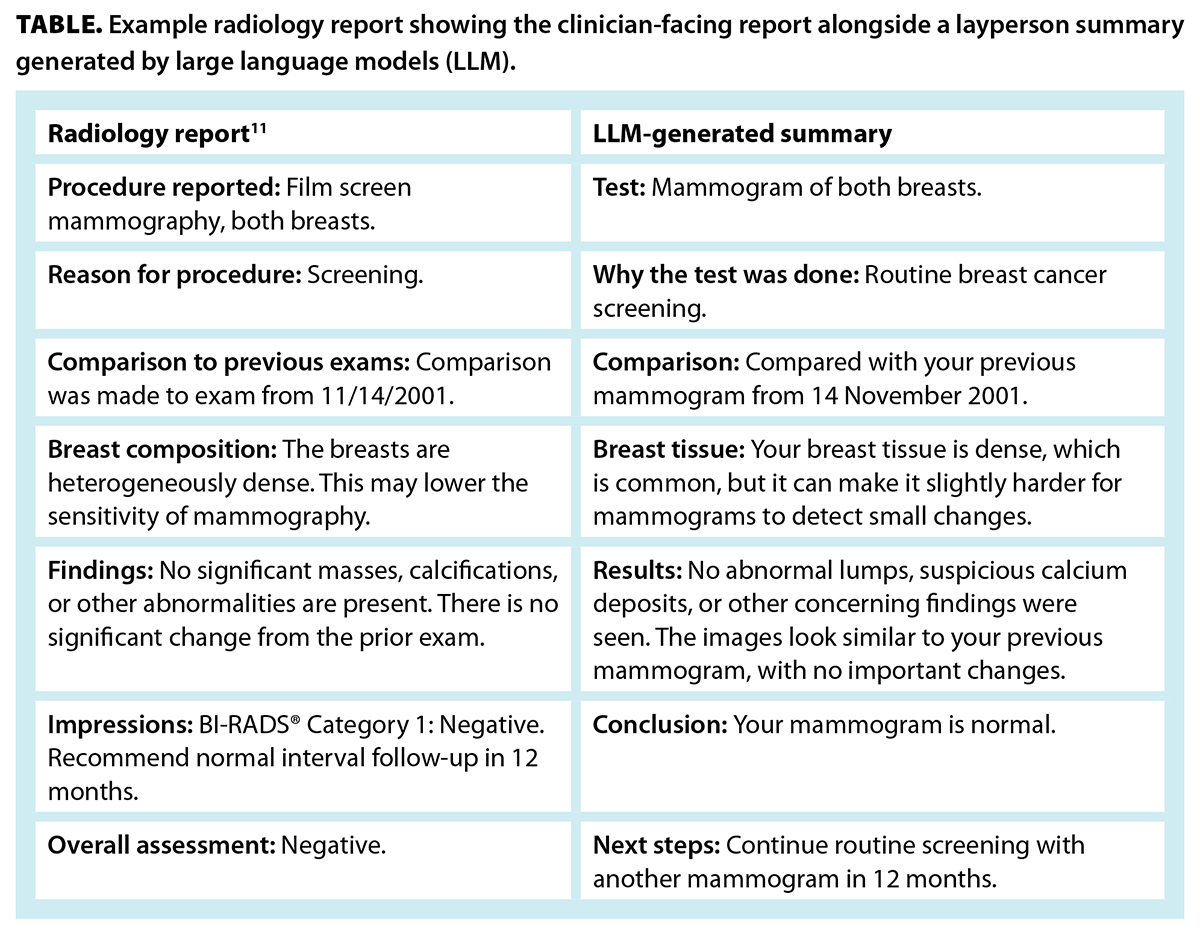
Portals can incorporate layered information structures, where the full clinician-facing report remains unchanged but is paired with a brief, automatically generated, patient-friendly summary that explains the main findings in plain language. Large language models (LLMs) have shown promise for improving comprehension by generating simplified reports in patient-friendly language [Table].[11] In a US national study of 2000 adults, participants who received LLM-generated plain-language radiology reports demonstrated significantly higher accuracy in comprehension (68.0% vs 58.0%; marginal difference of 10.8%) and follow-up understanding (64.5% vs 58.4%; marginal difference of 6.8%) compared with those who received traditional reports.[12] Critically, improvements were larger among participants older than 44 years of age and those with lower than a college education. This differential benefit pattern illustrates how LLM-assisted interventions can reduce comprehension disparities.
While reviewing LLM-generated summaries is currently the responsibility of the supporting clinician to ensure accuracy and safety, employing technical safeguards supports implementation. Constrained models that restrict the structure and content of LLM outputs through predefined templates or rules, combined with retrieval-augmented generation that draws on curated medical sources, may reduce the additional burden. A systematic review and meta-analysis of biomedical applications reported a 1.35 odds ratio increase in performance metrics such as accuracy and completeness relative to baseline LLM systems,[13] potentially enabling safer implementation while reducing the need for extensive manual review.
Embedding definitions for common radiologic terms, such as atelectasis, effusion, or indeterminate, through hover-over functions or clickable links can also help patients interpret unfamiliar terminology without initiating additional clinical encounters. Standardized explanations for phrases expressing diagnostic uncertainty, including “clinical correlation required” or “cannot exclude,” may further reduce misinterpretation. Incorporating these lay language summaries and glossaries directly into existing reports has been shown to have the greatest impact on patient understanding.[8] A systematic review has further demonstrated that these interventions have resulted in greater improvements in disadvantaged populations compared with those with higher literacy levels.[14] By adopting design features that support patient understanding while preserving the integrity of clinical documentation, health systems may promote patient well-being, health literacy equity, and system efficiency.
Emerging LLM tools are beginning to appear in BC’s radiology workflows. Vancouver Coastal Health is a core partner in Iris, described as Canada’s first artificial intelligence co‑pilot for diagnostic imaging, which integrates natural‑language processing tools to support quality assurance, patient monitoring, and follow-up.[15,16] Nationally, the Canadian Association of Radiologists is leading the Healthcare AI Validation Network,[16] which evaluates LLM‑enabled tools on Canadian data before broad deployment, and BC sites are expected to participate in these evaluations.
Conclusions
Radiology reports in the patient portal era reflect a broader shift toward openness in health care, offering patients unprecedented access to information that was once available only through clinicians. Yet access alone does not ensure understanding. The technical language, conditional phrasing, and timing of report release can create anxiety for many patients, particularly when results are viewed without contextual interpretation. It can also cause reassurance-seeking behaviors, adding strain to an already overburdened health care system. Through thoughtful design-focused portal modifications leveraging LLMs, we can enhance how patients understand their imaging results and navigate follow-up care. As patient portals continue to expand, aligning access with understanding will be essential to ensure that transparency benefits the patients it aims to empower.
Competing interests
None declared.
hidden
This article has been peer reviewed.

This work is licensed under a Creative Commons Attribution-NonCommercial-NoDerivatives 4.0 International License.
References
1. BC Cancer. More online access to cancer screening letters in B.C. Provincial Health Services Authority. 4 December 2024. Accessed 8 March 2026. www.bccancer.bc.ca/about/news-stories/stories/more-online-access-to-cancer-screening-letters-in-b-c.
2. British Columbia Ministry of Health. 2019/20 annual service plan report. 20 July 2020. Accessed 8 March 2026. www.bcbudget.gov.bc.ca/Annual_Reports/2019_2020/pdf/ministry/hlth.pdf.
3. Doctors of BC. BC patients will soon have direct access to diagnostic imaging results. 13 July 2023. www.doctorsofbc.ca/technology-digital-health/2023/bc-patients-will-soon-have-direct-access-diagnostic-imaging-results.
4. Liddy C, Moroz I, Affleck E, et al. How long are Canadians waiting to access specialty care? Retrospective study from a primary care perspective. Can Fam Physician 2020;66:434-444.
5. Martin-Carreras T, Cook TS, Kahn CE Jr. Readability of radiology reports: Implications for patient-centered care. Clin Imaging 2019;54:116-120. https://doi.org/10.1016/j.clinimag.2018.12.006.
6. British Columbia Ministry of Health. Diagnostic imaging reports: Frequently asked questions (FAQ). Health Gateway. Updated 12 March 2024. Accessed 8 March 2026. www2.gov.bc.ca/assets/gov/health/accessing-health-care/health-gateway/health-gateway-resources/health_gateway_diagnostic_imaging_faqs.pdf.
7. Brewer-Hofmann A, Sajjad S, Bekheet Z, et al. Factors influencing patient understanding of information on radiology examinations. Skeletal Radiol 2023;52:1503-1509. https://doi.org/10.1007/s00256-023-04301-y.
8. van der Mee FAM, Ottenheijm RPG, Gentry EGS, et al. The impact of different radiology report formats on patient information processing: A systematic review. Eur Radiol 2025;35:2644-2657. https://doi.org/10.1007/s00330-024-11165-w.
9. Perrin Hee BT, Farrell A, Beekman A, et al. Is zero a good score? A qualitative study of patients’ perceptions of radiology reports. Curr Probl Diagn Radiol 2026:S0363-0188(25)00195-1. https://doi.org/10.1067/j.cpradiol.2025.10.016.
10. Jensen KV, Morrison A, Ma K, et al. Low caregiver health literacy is associated with non-urgent pediatric emergency department use. CJEM 2025;27:17-26. https://doi.org/10.1007/s43678-024-00771-8.
11. DICOM Standards Committee. Supplement 79: Breast imaging report templates. Digital Imaging and Communications in Medicine (DICOM). 12 January 2004. Accessed 8 March 2026. www.dicomstandard.org/News-dir/ftsup/docs/sups/sup79.pdf.
12. Chen AH, Rudin RS, Levine DM, Mehrotra A. Improving patient understanding of radiology reports using generative artificial intelligence: A vignette study of 2000 US adults. J Am Med Inform Assoc 2026;33:326-335. https://doi.org/10.1093/jamia/ocaf187.
13. Liu S, McCoy AB, Wright A. Improving large language model applications in biomedicine with retrieval-augmented generation: A systematic review, meta-analysis, and clinical development guidelines. J Am Med Inform Assoc 2025;32:605-615. https://doi.org/10.1093/jamia/ocaf008.
14. Durand MA, Carpenter L, Dolan H, et al. Do interventions designed to support shared decision-making reduce health inequalities? A systematic review and meta-analysis. PLoS One 2014;9:e94670. https://doi.org/10.1371/journal.pone.0094670.
15. Digital. Iris: Project overview. Updated 16 October 2024. Accessed 7 March 2026. https://digitalsupercluster.ca/projects/iris/.
16. Health AI Validation Network. Accessed 8 March 2026. https://haivn.ca.
hidden
Ms Taing is a medical student at McGill University. She previously completed a master of science in clinical neuroscience at the University of Oxford. Her academic interests focus on artificial intelligence across neuro- and breast radiology; patient medical education; and equity, diversity, and inclusion. Dr Yong-Hing is vice chair of equity, diversity, and inclusion and a clinical associate professor in the Department of Radiology, Faculty of Medicine, University of British Columbia. She is past president of the BC Radiological Society and medical director of BC Cancer’s Breast Screening Program. She works at BC Cancer Vancouver, where she was medical director of breast imaging from 2017 to 2024; BC Women’s Hospital; and two UBC-affiliated community imaging clinics. She co-chairs the UBC Department of Radiology’s Equity, Diversity, and Inclusion Committee and previously chaired the Canadian Association of Radiologists’ Equity, Diversity, and Inclusion Working Group.
Corresponding author: Ms Monica Taing, monica.taing@mail.mcgill.ca.