A missing tale of psychiatry in British Columbia
Issue: BCMJ,
vol. 68, No. 9, November 2026
|
Pages 308-311 |
Premise
The histories of three provincial institutions—Woodlands in New Westminster, Riverview Hospital in Coquitlam, and the psychiatric services at Vancouver General Hospital—reflect the evolving social, ethical, legal, and therapeutic approaches that have shaped mental health care in BC for generations.
During my psychiatry residency at the University of British Columbia, I found myself drawn to the histories of the institutions that have shaped mental health care in the province—histories sometimes unfamiliar to the clinicians and trainees who work in the spaces those institutions left behind. As the philosopher Martin Heidegger suggested, good historical knowledge can guard against uncreative repetition:[1] the risk of redesigning what has already been tried or forgetting what has already been learned, at considerable cost. Three institutions offer a window into how psychiatric care in British Columbia evolved across more than a century: Woodlands in New Westminster, Riverview Hospital in Coquitlam, and the psychiatric services at Vancouver General Hospital.
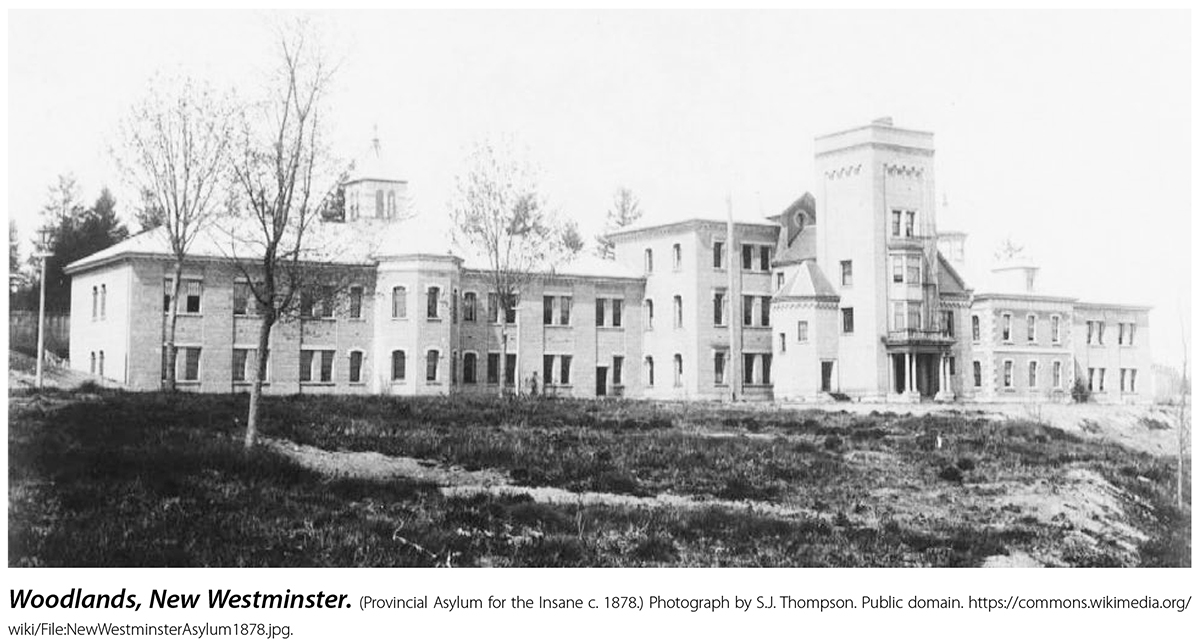
Woodlands, New Westminster (1878–1996)
The oldest of these institutions began in 1878 in New Westminster as the Provincial Lunatic Asylum (also referred to as the Provincial Asylum for the Insane), established to relieve overcrowding at an earlier facility in Victoria.[2] From its earliest years, the institution was marked by inadequate staffing, overcrowding, and conditions that drew criticism, including the use of handcuffs, leather mitts, and straitjackets.[2] In 1897, the name was changed to the BC Public Hospital for the Insane.[2] Conditions at the hospital prompted reform: Dr G.H. Manchester officially introduced the era of “moral treatment of insanity” in the 1902 annual report of the BC Public Hospital for the Insane, with principles that included medicine, good food, regular habits, employment, and recreation.[2,3]
In 1950, the facility was renamed Woodlands School, reflecting its focus on education and rehabilitation for people with intellectual disabilities, with other patients previously transferred to Riverview Hospital (then Essondale Hospital).[4] It reached its highest population in the late 1950s, housing over 1400 residents, including children and youth with developmental, behavioral, and psychiatric needs, as well as wards of the state.[4,5] Deinstitutionalization gradually reduced Woodlands’ population, and it closed in 1996, making British Columbia the first province in Canada to close large institutions for people with developmental disabilities.[4]
Closure did not end the institution’s public reckoning. In 2000, former residents came forward with accounts of physical, sexual, and emotional abuse. Former Ombudsperson Dulcie McCallum’s 2001 report The Need to Know found evidence of systemic abuse and recommended a formal apology and further investigation.[5] A class action lawsuit was filed, and a settlement was reached in 2009; in 2018, the provincial government provided ex gratia compensation to eligible survivors of Woodlands.[6] The main building was demolished in 2011, witnessed by survivors who had spent years seeking acknowledgment. A memorial garden now marks part of the site, recognizing the more than 3300 former residents buried in an associated cemetery, many of whose grave markers were removed and discarded in 1977.[4]
Riverview Hospital, Coquitlam (1913–2012)
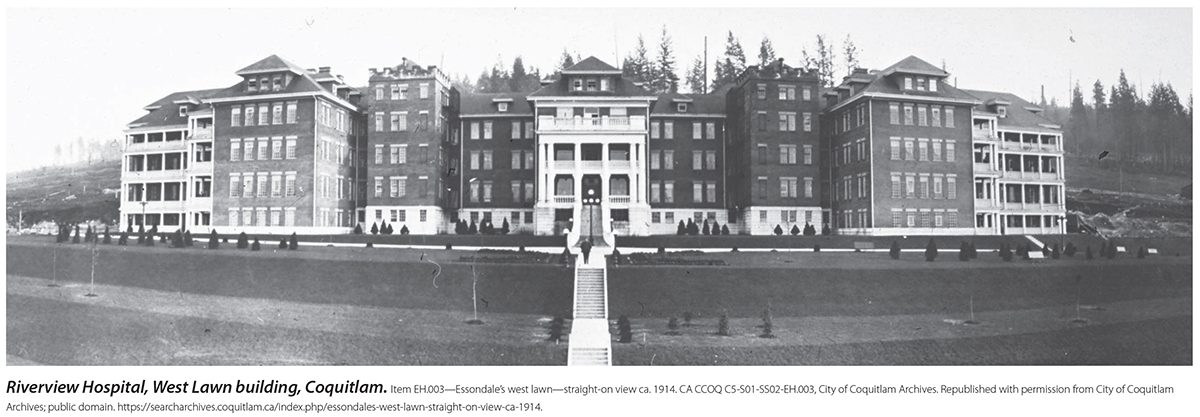
In 1904, the provincial government designated a 405-hectare site in Coquitlam for the proposed Hospital for the Mind at Mount Coquitlam. In 1913, before the hospital opened, the name was changed to Essondale Hospital, after the provincial secretary, Dr Henry Esson Young, to avoid confusion with the nearby town of Coquitlam. West Lawn, the first building, opened on 1 April 1913, and 340 male patients were later transferred from the BC Public Hospital for the Insane in New Westminster. Dr Young was influenced by ideas about the therapeutic value of nature, fresh air, and occupational activity, principles associated with the tradition of “moral treatment,” which emphasized humane psychosocial care over confinement.[7] As Andrew Merrill documented in Riverview Heritage Inventory, each decade brought new buildings, programs, and thinking about psychiatric care. The Essondale campus was officially renamed Riverview Hospital in 1965, the name by which it became widely known until its closure in 2012.[7] At its peak in 1956, the hospital housed more than 4300 patients and employed approximately 2200 staff members.[7]
The latter half of the 20th century brought fundamental change. The Canadian Mental Health Association’s 1963 report More for the Mind advocated for community-based care, and deinstitutionalization proceeded across Canada in the decades that followed.[8] In British Columbia, the number of psychiatric hospital beds decreased from 6371 to 3372 between 1965 and 1981, a decline of just over 47%.[9] Concerns about patient conditions were documented in the BC ombudsperson’s 1994 report Listening: A Review of Riverview Hospital.[10] A prospective study of 189 former Riverview patients found that the majority achieved stable community placements, although a subset had needs that could not adequately be met outside a tertiary hospital setting.[11]
In the early 2000s, concerns about electroconvulsive therapy (ECT) prompted an audit; the resulting Ministry of Health report concluded that ECT was being administered safely and effectively.[12,13] The episode reflected tensions between therapeutic innovation, institutional oversight, and public accountability. Among those who shaped Riverview’s later history was Dr Ralph Arrowsmith, known for his advocacy for marginalized populations and his commitment to psychiatric education. His reflections were documented in the 2012 film Consciousness, part of the Riverview Hospital Story Project, one of the few sustained efforts to preserve firsthand accounts of the institution before its closure.[14]
Riverview closed in 2012, a decision former BC attorney general Wally Oppal later described as the wrong one, “with 20/20 hindsight.”[15] The limited expansion of community-based mental health services relative to institutional closure contributed to ongoing challenges surrounding homelessness, addiction, and access to care.[16] The Riverview lands, known as səmiq̓ʷəʔelə (“Place of the Great Blue Heron”), are now home to the Red Fish Healing Centre for Mental Health and Addiction and the Provincial Assessment Centre, on the traditional territories of the kʷikʷəƛ̓əm (Kwikwetlem First Nation).[7] Growing up near what became the Riverview Heights neighborhood, I often passed these buildings before understanding their historical significance, a reminder that institutional histories can persist in a landscape long after the institutions are gone.
The shift toward hospital-based psychiatric services reflected a longer reorientation in psychiatry. As Dr Robert Nathan has argued, a model of the “psychopathic hospital,” situating psychiatric care in general hospitals rather than stand-alone asylums, had emerged in the late 19th century, reflecting psychiatry’s effort to align with general medicine and treat patients voluntarily.[17] This model positioned psychiatry as a branch of medicine rather than a system of custodial management, with implications for how patients were admitted, treated, and discharged. The development of psychiatric services at Vancouver General Hospital was, therefore, part of a much older professional transformation.
Psychiatric services at Vancouver General Hospital (1915–present)
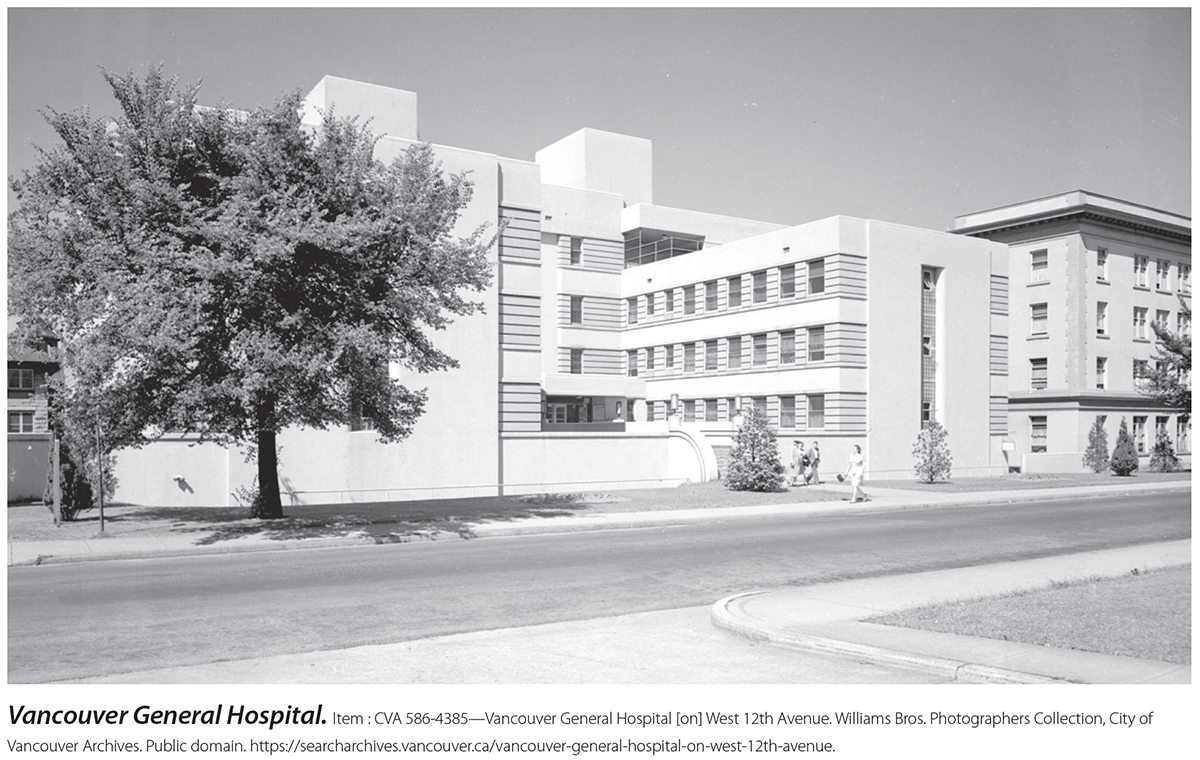
Psychiatric services at Vancouver General Hospital (VGH) developed alongside broader shifts in Canadian psychiatry toward treatment in general hospitals rather than stand-alone asylums. In 1915, VGH opened its first psychiatric ward, followed in 1920 by the establishment of a psychiatric clinic staffed by a psychiatrist, psychologist, and psychiatric social worker.[18]
By the early 2000s, CBC News investigations highlighted deteriorating conditions in VGH’s psychiatric facilities, including overcrowding, aging infrastructure, inadequate security, poor ventilation, and limited patient space.[19,20] Hospital figures reportedly showed that dispensing of antipsychotic medications had more than doubled over a 2-year period, a pattern the BC Nurses’ Union characterized as a form of “chemical restraint” in an overcrowded environment that staff felt could not otherwise be managed.[19] The director of mental health services acknowledged publicly that the building was “falling apart” and that renovation was no longer viable.[19] These conditions made visible a gap between the principles guiding psychiatric care and the physical environments in which care was delivered. The Joseph and Rosalie Segal and Family Health Centre, which subsequently opened on the VGH campus, reflected changing expectations about what a therapeutic environment should provide: private rooms, secure outdoor space, and a physical setting designed around the dignity and safety of patients.
The evolving legal framework
Alongside these institutional histories, legal frameworks governing psychiatric care evolved across successive generations in response to legal challenges, changing standards of consent, and expanding conceptions of patient rights. While reviewing provincial ECT guidelines published in 2002,[21] I encountered reference to the Health Care and Care Facility Review Board, established under the Health Care (Consent) and Care Facility (Admission) Act and later dissolved following legislative amendments in the early 2000s.[22] Its disappearance from the legislative landscape is a small illustration of how oversight mechanisms can be created, modified, and dissolved in a single generation, often without leaving clear traces in clinical practice or institutional memory. More recent decisions, including A.H. v. Fraser Health Authority, have continued to shape frameworks surrounding detention, consent, and patient autonomy.[23] These developments are easy to overlook in day-to-day clinical practice, yet they define the conditions under which patients are admitted, treated, and discharged.
Conclusions
These histories trace the arc of mental health care in BC, from the era of large custodial institutions through deinstitutionalization and into the present. Each institution reflects the social values, therapeutic assumptions, and political priorities of its time and carries forward unresolved questions about who receives care, under what conditions, and who bears the cost when standards of safety and dignity are not met.
Institutional memory fades quickly once physical spaces disappear. Woodlands has been demolished, Riverview’s grounds are being gradually repurposed, and the older VGH psychiatric wards are now green space. New facilities and policies do not emerge in isolation; they are shaped, whether acknowledged or not, by the generations of clinicians, patients, administrators, and communities that preceded them. The tale of psychiatry in British Columbia is not missing because nothing happened. It is missing because the histories embedded in these institutions have not yet been fully told.
Acknowledgments
The author thanks Dr Paige Zhang for her thoughtful feedback and insightful suggestions on this article.
Competing interests
None declared.
hidden
This article has been peer reviewed.

This work is licensed under a Creative Commons Attribution-NonCommercial-NoDerivatives 4.0 International License.
References
1. Heidegger M. Introduction to metaphysics. Fried G, Polt R, translators. New Haven, CT: Yale University Press; 2000.
2. Foulkes RG. British Columbia mental health services: Historical perspective to 1961. CMAJ 1961;85:649-655.
3. Scott K. Society, place, work: The BC Public Hospital for the Insane, 1872-1902. BC Studies 2011;(171):93-110. https://doi.org/10.14288/bcs.v0i171.336.
4. Inclusion BC. Institutions and people with intellectual disabilities: A BC history. Accessed 20 May 2026. https://inclusionbc.org/resource/institutions.
5. McCallum D. The need to know: Administrative review of Woodlands School. August 2001. Accessed 20 May 2026. https://inclusionbc.org/wp-content/uploads/2018/11/The_Need_to_Know.pdf.
6. Government of British Columbia. Woodlands’ survivors finally to receive redress from provincial government [news release]. 31 March 2018. Accessed 20 May 2026. https://news.gov.bc.ca/releases/2018PREM0013-000547.
7. Merrill A. Riverview heritage inventory [master’s project]. Vancouver: University of British Columbia, September 2009. Accessed 2 April 2026. https://open.library.ubc.ca/soa/cIRcle/collections/graduateresearch/310/items/1.0107188.
8. Marshall C. More for the mind: A study of psychiatric services in Canada. Toronto, ON: Canadian Mental Health Association; 1963.
9. Sealy P, Whitehead PC. Forty years of deinstitutionalization of psychiatric services in Canada: An empirical assessment. Can J Psychiatry 2004;49:249-257. https://doi.org/10.1177/070674370404900405.
10. Office of the Ombudsperson, Province of British Columbia. Listening: A review of Riverview Hospital. 4 May 1994. Accessed 20 May 2026. https://bcombudsperson.ca/investigative_report/listening-a-review-of-riverview-hospital/.
11. Petersen KL, Nicholls TL, Groden D, et al. Redevelopment of tertiary psychiatric services in British Columbia: A prospective study of clinical, social, and residential outcomes of former long-stay inpatients. Schizophr Res 2013;149:96-103. https://doi.org/10.1016/j.schres.2013.05.022.
12. CBC News. Top doctor at Riverview resigns. 27 February 2001. Accessed 2 April 2026. www.cbc.ca/news/canada/top-doctor-at-riverview-resigns-1.296463.
13. Gosselin C, Drance E, Eyre J, et al. Review of ECT practice at Riverview Hospital. HealthyPlace. 21 February 2001. Accessed 2 April 2026. www.healthyplace.com/depression/articles/review-of-ect-practice-at-riverview-hospital.
14. Nielsen LG (director), Currie H (producer), Tremere A (producer), et al. Consciousness (Riverview Hospital story project: Part three): [a story about Dr. Ralph Arrowsmith and Riverview Mental Hospital] [video recording]. 2012. Accessed 2 April 2026. https://dc.arcabc.ca/dc-faculty-research-scholarship/consciousness-riverview-hospital-story-project-part-three-story.
15. Judd A. Closing Riverview in 2012 was a ‘mistake,’ former attorney general tells safety forum. Global News. 23 January 2025. Accessed 2 April 2026. https://globalnews.ca/news/10974077/save-our-streets-bc-safety-concerns/.
16. Morrow M, Frischmuth S, Johnson A. Community-based mental health services in BC. Changes to income, employment, and housing supports. Canadian Centre for Policy Alternatives, BC Office. August 2006. Accessed 20 May 2026. www.policyalternatives.ca/wp-content/uploads/attachments/community_mental_health_services.pdf.
17. Nathan RDF. The psychopathic hospital. Hist Psychiatry 2023;34:417-433. https://doi.org/10.1177/0957154X231194910.
18. Williams EA. Psychiatric facilities and social case work services in a hospital setting: A review of developments in the Vancouver General Hospital (1915-1950) [master’s thesis]. Vancouver: University of British Columbia, 1951. https://open.library.ubc.ca/soa/cIRcle/collections/ubctheses/831/items/1.0106833.
19. Tomlinson K. Families slam aging, overcrowded psych ward. CBC News. Updated 20 September 2011. Accessed 2 April 2026. www.cbc.ca/news/families-slam-aging-overcrowded-psych-ward-1.1006605.
20. Tomlinson K. Missing patients, illicit drugs in Vancouver hospital. CBC News. Updated 12 September 2011. Accessed 2 April 2026. www.cbc.ca/news/missing-patients-illicit-drugs-in-vancouver-hospital-1.1077722.
21. Mental Health Evaluation & Community Consultation Unit. Electroconvulsive therapy: Guidelines for health authorities in British Columbia. August 2002. Accessed 2 April 2026. www.sfu.ca/content/dam/sfu/carmha/resources/ect-guidelines/Electroconvulsive%20Therapy%20-%20Guidelines%20for%20Health%20Authorities%20in%20British%20Columbia.pdf.
22. Health Care (Consent) and Care Facility (Admission) Act, RSBC 1996, c 181. Accessed 2 April 2026. www.bclaws.gov.bc.ca/civix/document/id/complete/statreg/96181_01.
23. Supreme Court of British Columbia. A.H. v. Fraser Health Authority, 2019 BCSC 227. Accessed 2 April 2026. www.bccourts.ca/jdb-txt/sc/19/02/2019BCSC0227cor1.htm.
hidden
Dr Lam is a BC Centre on Substance Use addiction medicine fellow at St. Paul’s Hospital and a year 5 psychiatry research track resident at the University of British Columbia. His clinical and research interests include addiction psychiatry, forensic psychiatry, correctional mental health, and the history and philosophy of psychiatry.
Corresponding author: Dr Austin Lam, austinl5@student.ubc.ca.