By: Cecil Hershler, MD, PhD, FRCPC
A healing journey
Issue: BCMJ,
vol. 67, No. 9, November 2025,
Pages 329-331 Physician Spotlight
Using the stories we tell—stories of our healing processes—to obtain insight into our lives and an enhanced sense of well-being.
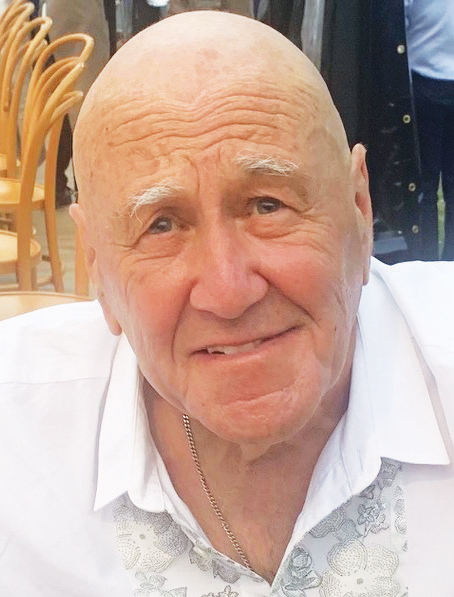 |
| Dr Cecil Hershler |
When I immigrated to Canada from South Africa in 1974, I was ashamed to talk about my birth country. My shame came from being born into privilege—a young middle-class White boy in a racially segregated apartheid country. In the early 1980s, in the middle of my residency in physical medicine and rehabilitation, while still at McMaster University, I attended a concert at the Hamilton Centre for Civic Inclusion. The main draw was Ann Mortifee, a well-known and acclaimed Canadian singer. In the concert program, I read that Ms Mortifee had also been born in South Africa. Intrigued, I went to the stage door after the show and introduced myself to her. After a brief conversation, she invited me to visit her when I next came to Vancouver. In 1985, after I completed my training, my family—now with four children—relocated to Vancouver.
In 1987, I attended a 4-day workshop at the Hollyhock Retreat Centre on Cortes Island facilitated by Ms Mortifee. It was called Releasing the Inner Voice. I thought it would be about releasing inhibitions about singing. It turned out to be more about expressing one’s emotions related to feeling inhibited. Singing on one’s own or in a group was one way to encourage this release.
During one lunch break, I went for a walk in a nearby forest and got lost in the gloom of the trees and bushes. I felt desperate. I was constantly on the wrong path and hitting dead ends. I didn’t know if I would get out. After stumbling around and trying different paths, I finally found my way out of the trees and into the sunlight. I felt a great sense of relief.
I rejoined the workshop 30 minutes late. Embarrassed, I tried to explain my late arrival to the group. It was then that something strange occurred. To this day, I cannot explain it. It was not logical. I became The Blind Deerhunter. My first name, Cecil, is based on the English root for blindness, while Hershler is derived from the word hirsch, which means deer in German and can be interpreted as deer hunter. I am, by nature, reserved. I have always been drawn to rational and logical ways of speech and thought. I enjoy and appreciate the beauty of mathematics and the way it explains physical phenomena. But, on that day, I described my experience using metaphor. I had never done this before. My getting lost in the forest and finding my way out became the blind deer hunter’s journey to a “vision.” This vision was not the same as seeing in the physical sense.
It took over 20 years of experiencing privilege in South Africa before I realized the injustice and unfairness of the apartheid system. The meaning of my name resonated with my lack of awareness of the inherent racism and discrimination of apartheid during those years. The apartheid system left a legacy of inequality that we are still dealing with today. I related the adventure of my forest wanderings in a mythic way. Through the metaphor, I saw the pattern of my life more clearly. The experience had a healing or therapeutic potential. I was impressed by how I felt as a result of both being in the workshop and the mythic telling of the story. If I could gain insight and closure by expressing my feelings metaphorically, then I felt others could do the same, albeit in different contexts.
After the workshop, Ms Mortifee and I met on several occasions and discussed repeating her workshop with participants who were challenged by a physical disability. We invited some of the people I was seeing at my medical clinic to a pilot workshop we ran in Vancouver in 1988 called Facing the Challenge with Song, funded by the Rotary Club of Vancouver. For one weekend, Ms Mortifee led 20 people, eight of whom had physical disabilities, and their friends or family members, in exploring the therapeutic potential of singing. After the workshop, all the participants felt an enhanced sense of well-being. In this workshop, I saw that music and song could help people express emotions of fear, grief, and even anger, but also go beyond those emotions and become aware of their strengths and find hope even when a situation appeared bleak.
We then began to plan a more ambitious workshop involving several expressive arts. We named our collaborative project the Healing Journey. At the heart was an intuitive feeling that people could be assisted in their healing process by using artistic approaches such as music, song, art, theatre, and storytelling or writing to retell the story of their pain or chronic illness. If the retelling involved metaphor or myth-making, all the better.
Both Ms Mortifee and I felt that we could all benefit from claiming and valuing the artistic side of ourselves and that it would change attitudes toward disease, illness, physical disability, and mental health. It was an attempt to look more closely at the concept of healing.
In 1992, I was fortunate to obtain approximately $100 000 from the BC Health Research Foundation to undertake this research. The experiment took the form of three weekend workshops in which drama, singing, and storytelling were interwoven. The Healing Journey was based on The Hero’s Journey, as described by Joseph Campbell.[1] Each weekend had a purpose (both real and mythic): the leave-taking, the trials, and the homecoming. The use of a mythic journey as a metaphor gave participants the chance to experience themselves as they were—permission to be what they could not be in life. Enacting the metaphor gave participants the opportunity to stretch out, let go of inhibitions, and open up repressed personalities.
The central participants were physically challenged in some way—paraplegia, post-polio syndrome, AIDS, chronic fatigue syndrome, cancer, scleroderma, or Crohn disease. Each was accompanied by a family member or friend and a health care professional, forming triads that worked together with the idea that the workshop would support growth in their long-term relationships.
To facilitate the drama component of the workshops, Ms Mortifee and I chose Trish Grainge, a clinical counselor, a professional actress, and one of the few registered drama therapists practising in Canada. In the Healing Journey, the triad of “elders,” or facilitators, was Ms Mortifee (song), Ms Grainge (drama), and me (story). The health care professionals in this project were two family physicians, a psychiatrist, a nurse, a music therapist, an occupational therapist, and a massage therapist. The workshops were filmed by Vancouver-based Ark Films, and participants answered a list of questions on video before and immediately after completing the three workshops, then again 6 months later.
An expert review panel led by psychologist Dr James (Jim) Frankish of UBC’s Department of Health Care and Epidemiology prepared the questions and evaluated the participants’ responses as well as the questionnaires they filled in at the same time.
Finally, the hundred hours of film were edited into a video, also called The Healing Journey, which is available with a study guide as a learning tool for therapists and facilitators. To receive a copy of The Healing Journey Study Guide (in booklet form), email chershler@gmail.com.
When test results were examined 6 months after the workshops, all of the participants’ results on a standard quality of life questionnaire were higher, but the one statistically significant test result was an improvement in mood reported by the health care professionals.
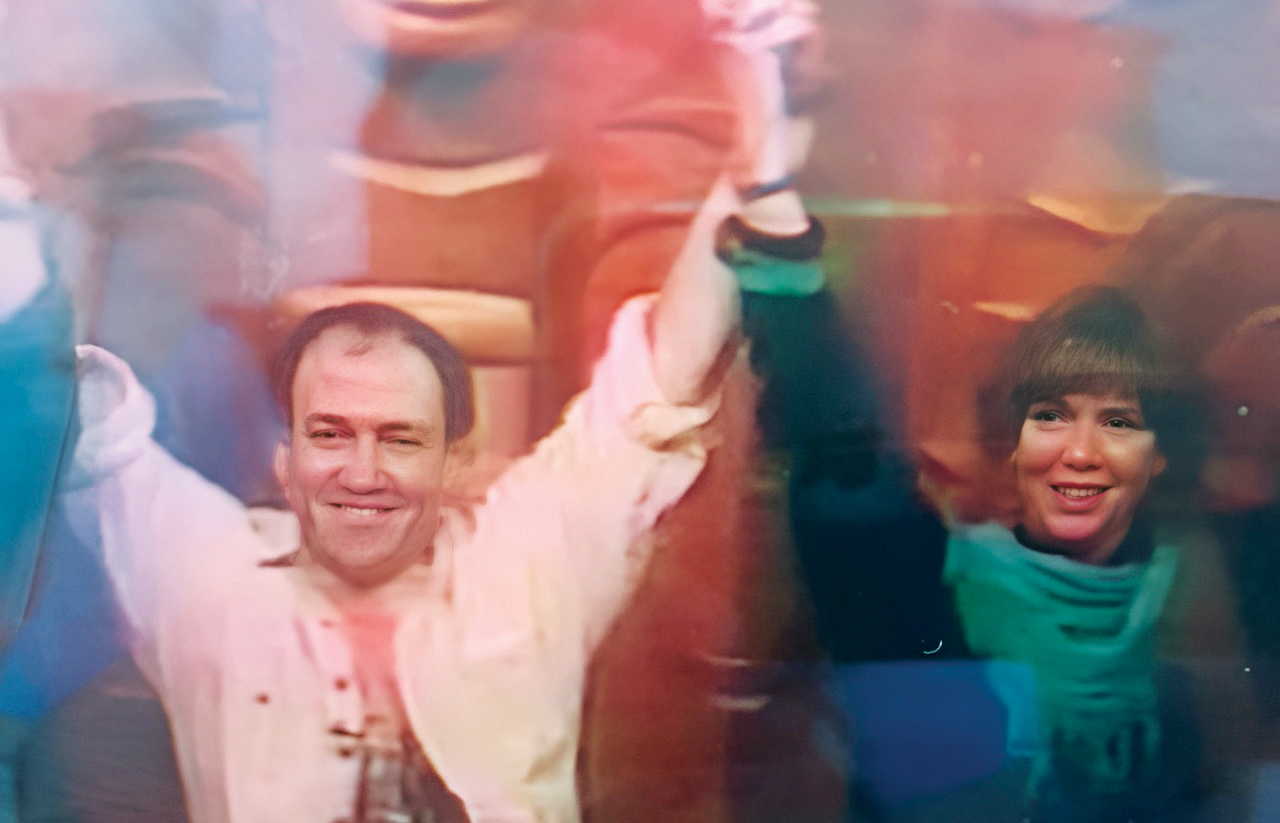 |
| Dr Cecil Hershler and Ms Ann Mortifee during a Healing Journey workshop in 1992 |
Postproject
After the Healing Journey project, I felt different and began to tell stories of my childhood in a public fashion at storytelling festivals, storytelling evenings, and community events, and I even acted in a South African play in 1997.[2] I realized that for almost 20 years after leaving South Africa and arriving in Canada, I had not spoken much about my childhood. I had felt inhibited and ashamed to speak about my years growing up as a privileged White person in a racist system.
The first story I developed concerned what I thought was a betrayal of a childhood friendship with a Black South African, Sidwell. Sidwell was the head waiter at a hotel owned by my parents. When I was a child of 5 years, Sidwell had taught me a hand gesture—a fist with the thumb projecting between the index and middle fingers—which I had interpreted as acceptance and friendship. In fact, Sidwell had put me on his shoulders and danced me around in celebration. As a teenager in a private White school in South Africa, I learned that this gesture was, in fact, used in a demeaning and derogatory manner (similar to giving someone the middle finger). This made me angry: I felt Sidwell had betrayed our friendship.
Thirty years after coming to Canada, I descended off a plane onto the tarmac in Rio de Janeiro to discover multiple carvings of Sidwell’s hand gesture in brass, wood, and stone in the arrivals hall. From a souvenir seller, I learned that the hand gesture was a sign of both good luck and protection. The hand warded off evil spirits and enhanced strength and fertility, and solid replicas had been in the possession of slaves when they were forcibly abducted from West Africa to South America. As I stood there, tears in my eyes, my sense of betrayal dissolved, and I believed that Sidwell had given me, a small White child, his protection and friendship.
In 2002, my wife Ruth and I created a charitable foundation, Education without Borders, which supports poorly resourced and disadvantaged schools in the Western Cape region of South Africa. I committed afresh to reestablishing a link with South Africa. For over 15 years, assistance has been given to hundreds of students in mathematics and English literacy, and this June, Education without Borders received its first-ever grant to implement in-school gender-based-violence workshops specifically aimed at assisting young teenage girls in South Africa in developing defences against sexual abuse.
The Healing Journey also led to a change in how I practised medicine. I introduced the rose and thorn program into my clinical practice for one afternoon per week. It was a program dealing with chronic pain management in a group of patients with fibromyalgia using journal writing (with professional writer Dale Adams Segal); storytelling (with me); and guided imagery, relaxation, and gentle movement exercises (with physiotherapist and counselor Eva DiCasmirro).
The intention was not only to provide the patients with pain management tools and strategies, but also to restore their dignity and sense of agency in relation to their pain and illness. The patients attended consistently and reported an improvement in mood and pain management over the years. The group ran for 10 years.
I believe the stories we tell are stories of our healing process. If we can create myths based on our own unique events and stories—even stories of pain and illness—we will obtain increased insight into our lives and an enhanced sense of well-being.
hidden
 |
| This work is licensed under a Creative Commons Attribution-NonCommercial-NoDerivatives 4.0 International License. |
References
1. Campbell J, Moyers B. The power of myth. New York, NY: Vintage Books; 1988.
2. Fugard A. Valley song. Vancouver Fringe Festival, 1997.
hidden
Dr Hershler is a physician, storyteller, poet, and actor. After immigrating to Canada in 1974, he maintained links with his birth country, South Africa, by creating a charitable foundation with his wife Ruth to work with poorly resourced and disadvantaged youth in South Africa as well as Indigenous youth in Canada. Dr Hershler is now retired after 40 years as a physician specializing in physical medicine and rehabilitation.


Thank you, Dr. Hershler, for sharing details of your own healing journey which led you to help others. It's an inspiring story.