
Dr Gordon E. Dower, 1923–2022
Issue: BCMJ,
vol. 68, No. 3, April 2026,
Pages 110-111 Obituaries
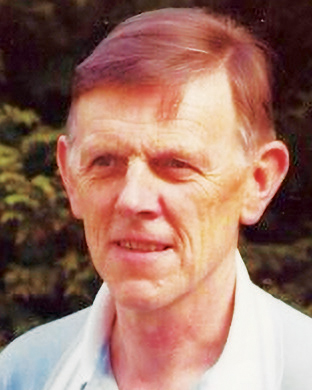
Dr Gordon E. Dower passed away on 9 December 2022. He was born on 16 November 1923 in Cardiff, Wales, to Dr Alexander Dower and Phyllis Dower (nee Ewbank). Gordon was accepted by St. Bartholomew’s Hospital to study medicine. The teaching labs were destroyed by a bomb in World War II, so his class was transferred to Cambridge, where he met his future wife, Helen Lucas-Smith.
Gordon finished his hospital training and several house jobs at Bart’s before enlisting in the Royal Canadian Air Force as a medical officer, with postings in Chatham and Ottawa. On completion of his service, Gordon, Helen, and their infant daughter drove across Canada to Vancouver seeking a warmer climate. He visited the fledgling medical school at the University of British Columbia and was offered a job in the Faculty of Medicine, where he stayed until his retirement.
Gordon preferred research to medical practice and was particularly intrigued by the electrical activity of the heart. He developed a xenobiotic long-term culture of myocardial cells to study drug effects in vitro. He was part of Dr Murray Newman’s investigation team studying the orca in captivity, and in 1964, he took the first ECG on an orca, Moby Doll, using plumbers’ aids as suction cups for the leads. Gordon also developed the field of polarcardiography, in which the electrical activity of the heart is displayed as a vector over time. He also invented the EASI lead system, which uses a small number of leads to derive a 12-lead ECG using a computer. The device was used on the space shuttle Challenger missions to monitor astronauts’ heart activity and is used for telemetry in hospitals. He was also a fellow of the American College of Cardiology and published over 50 scientific articles.
In retirement, Gordon continued to invent, and he built the Ridek electric car. At the time, battery charging was slow, and the premise was to swap out the battery deck while retaining the ride-on component. He attended many electric vehicle conventions, including one in Long Beach to celebrate his 80th birthday with his family.
Gordon went on his first flight at 5 years old, using his allowance at a local exhibition. He waited 40 years to qualify as a fixed-wing pilot and took to flying a helicopter upon retirement. When he was refused a car rental in Ireland at the age of 81 while attending an electric vehicle convention, he instead rented a helicopter to explore the Emerald Isle.
At age 90, he received a new aortic valve via transcatheter implantation and had almost another decade of happy life. He moved to the Tapestry retirement community at Wesbrook Village at age 93 and made many friends. He presented talks on a variety of topics to the group, including “Why Einstein was wrong.” Gordon was an avid runner and continued jogging until an injury at age 98. In his final illness, he opted for medical assistance in dying and was with family when he left us.
Gordon is survived by his daughters, Julia (Karl), Nancy (Jim), and Lin; grandchildren, Wendy, Sheila, Kate, Jill, and David; and great-grandchildren, Ry, Erika, Thor, Linnaea, Jimmy, Miles, Teagan, and Teddy. He was predeceased by his wife, Helen, and son, Roger.
Gordon was an eternal optimist with a brilliant mind, a love of family, and an interest in learning.
—Nancy Dower, MD, PhD, FRCPC

This work is licensed under a Creative Commons Attribution-NonCommercial-NoDerivatives 4.0 International License.
When he was refused a car rental in Ireland at the age of 81 while attending an electric vehicle convention, he instead rented a helicopter to explore the Emerald Isle.
This must have touched his good sense of humor.