Primary care is the focus of Simon Fraser University’s new School of Medicine
Issue: BCMJ,
vol. 68, No. 6, July August 2026,
Pages 196-198 Interviews
As Simon Fraser University opens its doors to its first class of medical students, the BCMJ spoke with Dr David Price, dean of medicine.
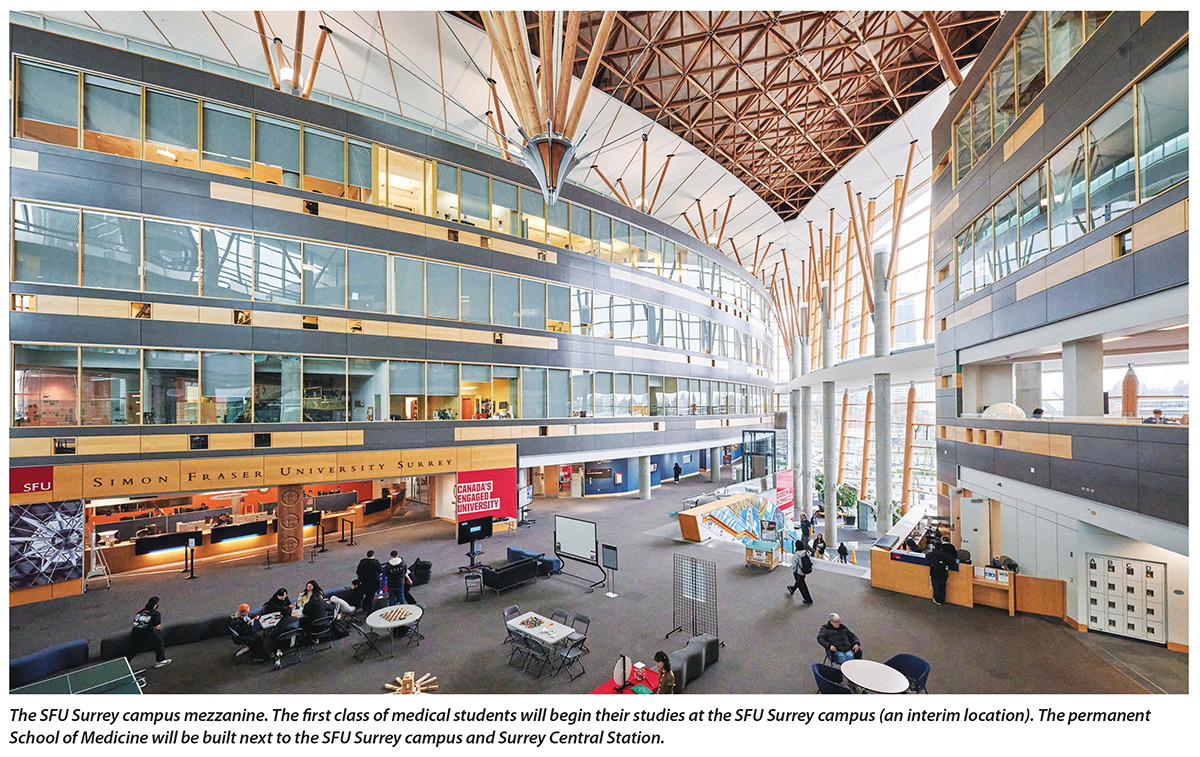
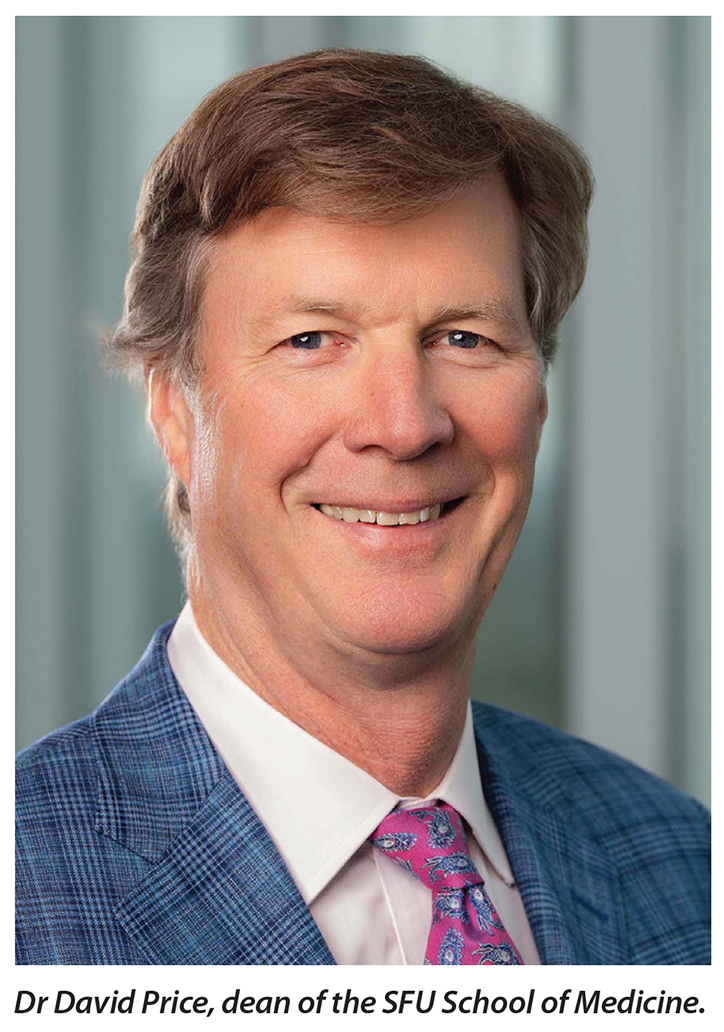 In August 2026, the first new school of medicine in Western Canada since 1950 is welcoming its first students. The Simon Fraser University (SFU) School of Medicine, with a curriculum centred on family medicine and primary care specialties, aims to improve access to primary care in BC by training physicians to work in urban, rural, remote, and Indigenous communities.
The university’s founding dean of medicine, Dr David Price, set out to create a medical school that flips the script on traditional physician training. Unique health care challenges require unique solutions, and with 35 years’ experience in community-based primary care specialties, Dr Price was well qualified to design a new kind of medical school. He explains: “What really interested me was thinking about primary care in a larger sense—was this going to be a family medicine–specific school, or would it be broader than that? So, to think about family medicine for sure, but to consider the other primary care specialties, like pediatrics, psychiatry, public health, emergency medicine, OB/GYN, and other community-based specialties, that’s what brought me on board. And, who gets the opportunity to help design a medical school from the ground up? It’s the opportunity of a lifetime.”
Initially invited to act as interim dean to help design the school, Dr Price went on to accept the permanent dean position. When he came on board, he first set out to consider community needs and find ways to focus the school’s curriculum and recruitment with a uniquely primary care lens.
Taking a fresh approach to designing a medical school curriculum presented some interesting challenges. “Any time you start a new endeavor like this, trying not to go down a well-trodden path and instead forge your own path, that engenders challenges,” says Dr Price. “If we’d tried to do it just like UBC or McMaster, or [the University of] Calgary, or McGill, then why create a new school? We can just do it exactly the same way it’s always been done. But if we do that, we’re going to get the same results that other medical schools across the country get: only 25% of students graduating from other Canadian medical schools choose family medicine, and only 30% to 35% choose any kind of primary care specialty. I’m a proud UBC grad; I was at McMaster and McGill, too. I’ve done accreditations and external reviews at about 70% of the medical schools in Canada, and those schools produce amazing graduates. But if we want to improve the number of students who choose primary care and other community-based specialties, we’re going to have to approach things differently.”
One of the earliest decisions Dr Price and his colleagues made was to flip the medical school’s learning curriculum from a hospital to a community focus. “In most medical schools, students spend 70% to 80% of their time learning, either in the university or in the hospital, and then spend 20% to 30% out in the community. We’re flipping that. We’re saying we want to do 70% or so in the community and 20% to 30% in the hospital. And that creates its own challenge: helping the hospitals and health authorities understand that the training that happens in hospitals isn’t less valuable; it’s essential. But we need to ensure that the training our students receive is relevant for the profession we hope they go into, the profession they choose during the CaRMS Residency Match.”
Once Dr Price and his team landed on the school’s innovative curriculum ratio switch, it was time to get the government on board. “The challenge at that point was to convince the government that this all makes sense,” he explains. “The government wants us to produce more family physicians, but I’m not sure they’d really thought beyond that in terms of how to get there. And as we started to articulate our vision for a primary care–focused medical school (and yes, that took a bit of convincing), it’s evolved into a very supportive relationship with the bureaucrats and the various ministries.”
Dr Price identifies the partnerships developed in the school’s planning process as a win. “I’m proud not only of the team we’ve been able to recruit—from here in BC, and also from across the country and internationally—but also of the relationships we’ve built,” he explains. “The First Nations Health Authority has been incredibly supportive in helping us understand how to add Indigenous ways of knowing and being—and, more importantly, an Indigenous concept of wellness—to our curriculum, as well as how we approach faculty and staff and the culture in the school. Our partnerships with Fraser Health and the Divisions of Family Practice are also key. All our partners have asked really good questions; they’ve pushed us to think broadly, and they’ve been extraordinarily supportive, so all of that has played into how I think our school will evolve and grow.”
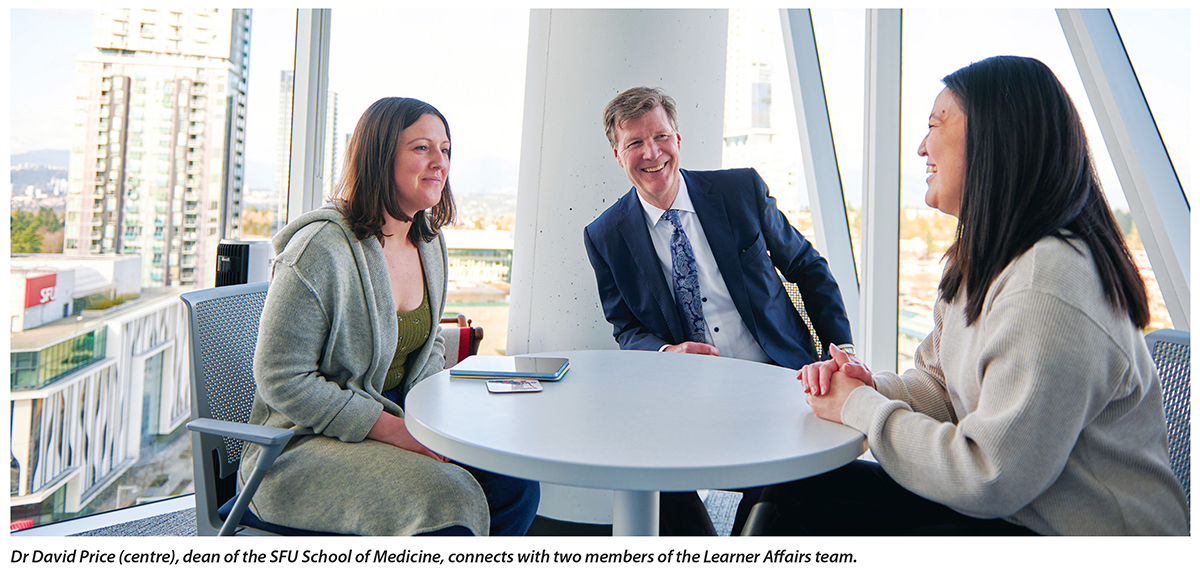
Recruiting faculty hinged on posting positions and getting the word out quickly. Once positions were posted, says Dr Price, there was a period of leveraging connections to encourage candidates to apply and convince them that it would be worth it to relocate and support the new school. “For many of our new faculty members, it was a bit of a leap of faith, but any dean can tell you that a big part of their job is to go out and recruit faculty and convince them that working for their own particular medical school is a really worthwhile endeavor.” While many faculty members are family physicians, other specialties are represented as well. “We have a number of clinical faculty who practise in specialties other than family medicine. One of our senior advisors from Fraser Health is an ophthalmologist, our associate dean of learners is a respirologist, but we’re a primary care school, so our faculty really is more focused in the primary care disciplines.”
Dr Price says that the SFU medical school will work with UBC’s medical school to find efficiencies by sharing resources whenever possible. “Our commitment to UBC, government, and BC taxpayers is that where there are opportunities to collaborate, we will. For example, we’re sharing call rooms in the hospitals, teaching centres, and so on. As well, the UBC faculty [have] been generous with their time, collaboration, and conversations to help us ensure we’re not reinventing the wheel. With that being said, there’s an hour between our campus and UBC, so it’s pretty tough to duplicate the use of some in situ learning materials, because it’s just too far. But when it comes to hospital settings, where there’s taxpayer-funded infrastructure, we’re going to be respectful in our use and sharing of that.”
The school has two selection streams for students: an open stream, available to all students from British Columbia and the territories, and an Indigenous stream, open to Indigenous students from across Canada. When it comes to students’ grade point average (GPA) and academic qualifications, the school will be taking a fresh approach. “With GPA, the evidence is that you need to have been generally successful in a rigorous academic program to then succeed in a program such as medicine. We know, based on evidence, the minimum [Medical College Admission Test] score you need to have to be successful in medical school. So if you clear that bar, we will no longer look at your marks—we’ll start to look at your other attributes. As a primary care medical school, we’re going to look at community engagement and connection activities that would demonstrate to us that you’re excited about a career in a primary care discipline.” Dr Price hopes that taking this approach to admissions will ease stress for students who have been solely focused on maintaining near-perfect grades. “We know that life happens,” he says. “Folks get sick, and you can’t always do as well. You get injured playing sports. A family member gets sick. You need to hold down a part-time job to help put yourself through school. There are all kinds of reasons why extraordinarily bright, capable, talented individuals can’t get that 3.9999 GPA but still do remarkably well, and those are the students that we hope will be able to demonstrate that they should be a part of our program.”
The school’s family medicine residency program will start on 1 July 2027, with a commitment to having the same proportion of residency spots as UBC and other medical schools across the country. “We’re starting with family medicine residencies, but our commitment is to increase to a number of other primary care residency specialties, like pediatrics, psychiatry, and general internal medicine,” says Dr Price.
There are still opportunities for BC physicians to get involved with the SFU medical school. “There are other focused teaching roles that will become available,” says Dr Price. “We have a great mix of clinical faculty so far, and we’d love to hear from you if you’d like to contribute.”
For a list of available positions at the SFU School of Medicine, visit www.sfu.ca/medicine/contact/careers.html.

This work is licensed under a Creative Commons Attribution-NonCommercial-NoDerivatives 4.0 International License.
hidden
Ms Lyon is production editor of the BC Medical Journal.