Commemorating 2 centuries since the death of the inventor of the stethoscope
Issue: BCMJ,
vol. 68, No. 3, April 2026
|
Pages 93-95,109 |
Beyond Medicine
| doi.org/10.66794/2bb2
The life and contributions of René-Théophile-Hyacinthe Laennec, one of medicine’s greatest figures.
This year marks the bicentennial of the death of René-Théophile-Hyacinthe Laennec (1781–1826), who revolutionized medicine with the invention of the stethoscope in 1816 and his pioneering studies in auscultation. By integrating clinical observation with pathological anatomy, Laennec transformed the practice of medical diagnosis. His seminal work, De l’auscultation médiate ou Traité du diagnostic des maladies des poumon et du coeur (1819), was a comprehensive treatise on diseases of the chest and the diagnostic value of auscultation.
Childhood
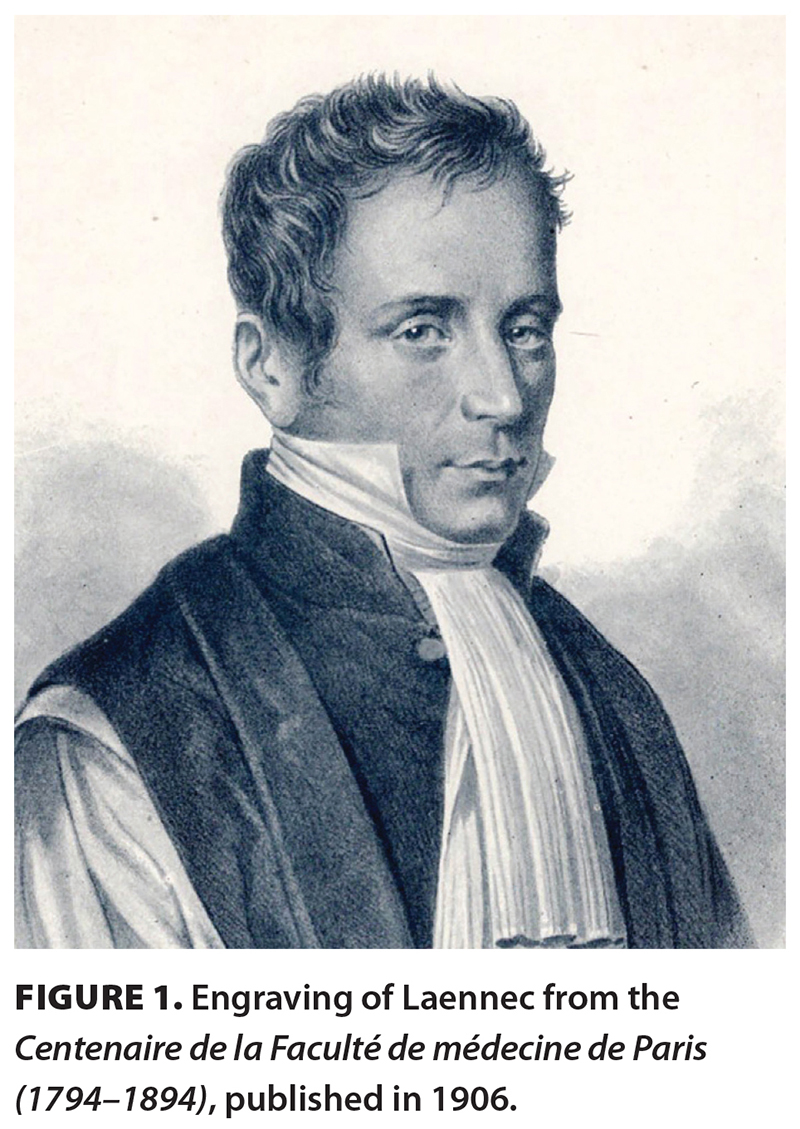 Laennec [Figure 1] was born on 17 February 1781 in Quimper, Brittany, in northwestern France. He was the first child of Théophile-Marie Laennec (1747–1836) and Michelle-Gabrielle-Félicité Guesdon (1754–1786). He had one brother, Michel (known as Michaud) (1782–1810), and one sister, Marie-Anne (1785–1853). His mother died when he was 5 years old. Both sides of his family included distinguished figures, some of whom served as mayors of Quimper, and others as lawyers.[1,2]
Laennec’s father was a lawyer, intelligent but also selfish and opportunistic. Unable to care for his children, he entrusted them to relatives. The two sons lived with their uncle, a priest, for a year. When this uncle was transferred to another city, he asked his other brother, Guillaume François Laennec (1748–1822), a physician in Nantes, to take charge of the boys.
The brothers arrived in Nantes on 15 May 1788. Théophile (as he was known to his close relatives) did not see his father for 9 years, until 1797. In the meantime, in 1794, his father remarried.
Laennec was profoundly influenced by his physician-uncle. Two of his cousins, Ambroise and Mériadec, also pursued careers in medicine. Mériadec became Laennec’s most devoted student, his chef de clinique, and the custodian of his scientific papers.[3]
Politics in his time
Laennec grew up during a period of great upheaval, witnessing the French Revolution, the First French Empire, and the Bourbon Restoration. To maintain control of France and combat both internal and external enemies, the revolutionary government instituted the Reign of Terror, one of its principal instruments being execution by guillotine. In Nantes, the guillotine was installed directly in front of Laennec’s uncle’s house in March 1793.
Brittany was home to numerous counter-revolutionary insurgents known as Chouans, and frequent clashes took place between them and government forces. To suppress the uprising, the National Convention dispatched Jean-Baptiste Carrier, who committed numerous atrocities in the region.
At 14 years of age, Laennec enlisted in the Revolutionary Army as a medical aide (1795–1800). The family’s economic situation was difficult, and in Laennec’s letters to his father, he frequently requested financial assistance. His father occasionally sent money, but it was never sufficient.
Medical studies
In April 1801, Laennec left Nantes for Paris to complete his medical studies. He proved to be a brilliant student and graduated from medical school in 1804. Deeply devoted to Hippocrates, he dedicated his thesis, The Doctrine of Hippocrates and Its Relation to Practical Medicine, to his physician-uncle.
Laennec studied under several of the most important physicians of the time, including Jean-Nicolas Corvisart, Jean-Noël Hallé, Philippe Pinel, and Guillaume Dupuytren. He also formed friendships with other prominent physicians, such as Gaspard-Laurent Bayle. Under the influence of Bayle, Laennec became a Royalist and a devout Catholic. Both men were members of the Congregation, a Catholic society. These convictions were not widely welcomed in postrevolutionary France.
Laennec worked at the Hôpital de la Charité de Paris under Corvisart. As a student, he meticulously recorded the case histories and physical examinations of nearly 400 patients. In 1802, he began publishing some of these observations; his first report concerned a patient with a remarkable cardiac condition. That same year, he described six patients who died of a disorder he termed peritonitis. This article brought him recognition and led to his appointment in Dupuytren’s pathology laboratory.
In 1803, he won two major prizes in medicine and surgery, respectively. At the same time, he began publishing articles on a wide range of subjects, including the tunics enveloping certain viscera, the lining membranes of the cerebral ventricles, the capsule between the acromion and the clavicle, the classification of parasites, and pathological anatomy, along with reviews of other physicians’ work. In addition to his superior knowledge of his native Breton language (a Celtic tongue), he had an excellent command of Latin and Classical Greek.
Medical career
Following graduation, Laennec aspired to become a professor, although this did not occur until after the Restoration. In the meantime, he practised medicine and continued to publish scholarly articles. He introduced a new classification for parasites and identified cirrhosis of the liver. He coined the term cirrhosis, from the Greek κιρρός, meaning “tawny” or “yellowish-brown,” referring to the characteristic color of a cirrhotic liver. Laennec’s cirrhosis is synonymous with alcoholic cirrhosis. He also published the first description of metastatic melanoma, which he termed melanosis.
These years marked a turning point in medicine, as new ideas began to replace long-standing beliefs. For centuries, the cause of disease had been attributed to imbalance in the four humors. Dissection was uncommon, and diagnosis relied primarily on limited inspection, pulse description, and urine observation. Significant change began with the study of human anatomy through careful dissection by Andreas Vesalius, whose work De Humani Corporis Fabrica Libri Septem (1543) challenged Galen’s anatomical assumptions. With enhanced anatomical knowledge, progress in physiology was made by William Harvey, who discovered the circulation of blood, and in anatomical pathology by Théophile Bonet and Giovanni Battista Morgagni.
A major advancement in physical examination came with the invention of percussion by Leopold Auenbrugger, published in his Inventum Novum (1761). This technique fell into relative obscurity until rediscovered by Corvisart. By the turn of the 19th century, France had become the centre of the medical world with the establishment of the French Clinical School, a term used by medical historians to describe the approach French physicians took in diagnosing patients at that time (i.e., diagnosis through detailed patient history and physical examination, subsequently confirmed by autopsy). Corvisart made extensive use of percussion, and it was said that he could predict pathological findings later confirmed at autopsy.
At the time Laennec entered medical school, diseases were classified primarily by symptoms. One authority in this approach was Pinel, who described his method in Nosographie philosophique ou La méthode de l’analyse appliquée à la médecine. Young physicians of the period, including Laennec’s friend Gaspard-Laurent Bayle (in his 1802 thesis), criticized Pinel and advocated for disease classification based on anatomical localization.
Laennec’s primary field of study was pathological anatomy. He lectured on the subject, attempted to classify diseases by their anatomical basis, and even intended to publish a book on the topic, although he never completed it.
In 1816, Laennec was appointed chief physician at the Hôpital Necker–Enfants malades. Seeking a more effective method for chest examination, he found the traditional approach—placing the ear directly on the patient’s chest—crude and uncomfortable. According to his friend Jacques Alexandre Lejumeau, one day, while observing children playing in the Louvre, he noticed one child strike one end of a long wooden stick while another placed their ear at the opposite end, successfully perceiving the transmitted sound. Inspired, Laennec applied the principle to his medical practice: he rolled a piece of paper, placed one end on the chest of a young female patient with cardiac symptoms and the other to his ear, and noted that the sound was transmitted more clearly than with the traditional method.[4]
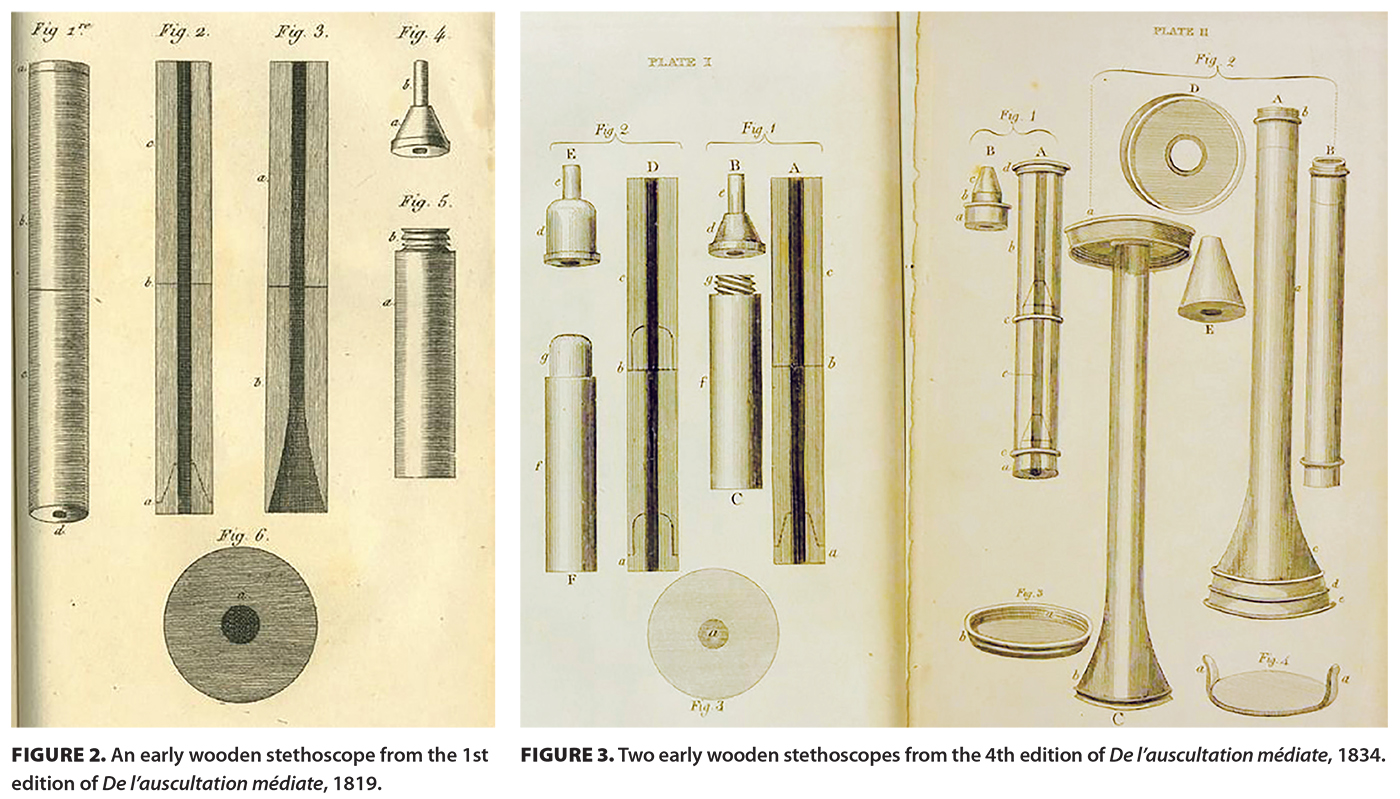
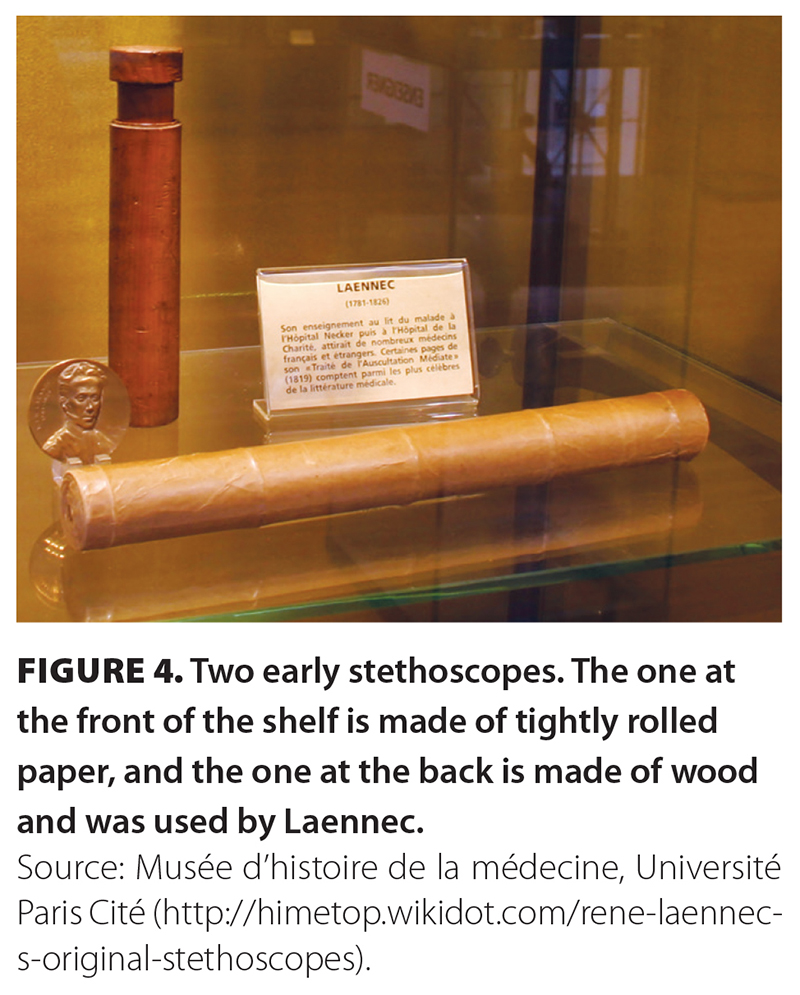 Laennec named the instrument the stethoscope [Figures 2 and 3] and the technique auscultation. He subsequently refined the device using various woods [Figure 4] and examined numerous patients, systematically correlating auscultation findings with autopsy results. These investigations culminated in his seminal work, De l’auscultation médiate, published in 1819.[5]
Dr Ralph H. Major wrote: “It was far more than a manual for the stethoscope. It was also a treatise on diseases of the lung and the heart, a mine of information on the clinical aspects of pulmonary and cardiac disease, with an accurate description of the pathological anatomy of these conditions. Laennec heard with his stethoscope sounds never before heard or described and for which no terms existed in medical literature. He was the creator of a large number of words now commonly used in physical diagnosis.”[6]
At first, this invention was viewed with suspicion and even ridicule; some physicians called it a “French toy.” However, unlike Auenbrugger’s percussion, it was soon accepted in France and other countries.
Laennec put great effort into the publication of his book and became quite exhausted and ill. In a letter to his father, he wrote: “I knew I was risking my life, but the book I am going to publish will, I hope, sooner or later be useful enough to be worth more than a man’s life, and therefore it was my duty to finish it, whatever might happen to me.”[7]
He went to Brittany to rest and later returned to Paris to continue his work. Shortly afterward, his teacher and patron, Hallé, passed away, and Laennec succeeded him as professor of medicine. He was also admitted to the Légion d’honneur.
In 1823, Laennec began working at the Hôpital de la Charité. Medical students as well as physicians from France and abroad attended his classes to learn firsthand about his invention and his approach to patients. He was very kind and courteous to foreigners, particularly the English. At the same time, he was preparing the second edition of his book, which he published in May 1826.
End of life
Suffering from the terminal stage of tuberculosis, Laennec returned to his home in Brittany and died on 13 August 1826,[8] at the age of 45. No postmortem examination was performed.[9]
He married Jacquemine Guichard (1779–1847) 2 years before his death. The couple had no children.
Legacy
A devout Catholic and a compassionate physician, Laennec remained dedicated to his patients until his death. His name was immortalized by the invention of the stethoscope and the publication of his seminal book, and his legacy endures. The stethoscope continues to serve as a universal symbol of the medical profession. Major medical schools now conduct “stethoscope ceremonies” to welcome new students into the profession.
hidden
This article has been peer reviewed.

This work is licensed under a Creative Commons Attribution-NonCommercial-NoDerivatives 4.0 International License.
References
1. Rouxeau, A. L’enfance et la jeunesse d’un grand homme: Laennec avant 1806, Quimper, Nantes, Paris, 1781-1805, d’après des documents inédits. Paris: J.-B. Baillière et fils; 1912. pp. 10-16.
2. Saintignon H. Laennec: Sa vie et son œuvre. Paris: J.-B. Baillière et fils; 1904. pp. 17-24.
3. Duffin J. To see with a better eye: A life of R.T.H. Laennec. Princeton, NJ: Princeton University Press; 1998. p. 111.
4. Lejumeau, JA. Inauguration de la statue de Laënnec à Quimper. Bulletin de l’Académie impériale de médecine 1868;33:807-816.
5. Laennec R-T-H. De l’auscultation médiate ou Traité du diagnostic des maladies des poumons et du cœur, fondé principalement sur ce nouveau moyen d’exploration. Two volumes. Brosson et Chaudé, Paris, 1819.
6. Delp MH, Manning RT. Major’s physical diagnosis. 8th ed. Philadelphia, PA: W. B. Saunders Company; 1975. pp. 12-15.
7. Rouxeau A. Laennec après 1806, 1806-1826, d’après des documents inédits. Paris: J.-B. Baillière et fils; 1920. p. 219.
8. Laennec, R-T-H. Traité de l’auscultation médiate et des maladies des poumons et du cœur. Two volumes. 2nd ed. Paris: J.-S. Chaudé, Libraire-Éditeur; 1826.
9. Lejumeau, JA. Notice sur le Professeur Laennec. Nouvelle bibliothèque médicale 1826;3:316-325.
hidden
Dr Dolatabadi is a neurology consultant in Medicine Hat, Alberta.