Recommending the appropriate naloxone formulation for the patient
Issue: BCMJ,
vol. 68, No. 7, September 2026
|
Pages 254-255 |
BC Centre for Disease Control
| doi.org/10.66794/2c5d
Both nasal and intramuscular (injectable) formulations of naloxone are now available through the BC Centre for Disease Control’s Take Home Naloxone (THN) program, which provides naloxone and overdose response training at no cost to anyone likely to witness or respond to an overdose event. Between January 2019 and April 2025, naloxone distributed through the program is estimated to have prevented 37 200 death events due to opioid toxicity.[1]
The THN program initially offered only intramuscular naloxone. Following a nasal THN pilot launched at select sites in 2024, the program received 2 years of additional funding in 2026 to expand access to nasal naloxone across all THN sites, in alignment with national guidance recommending the availability of both formulations.[2]
Both intramuscular and nasal naloxone contain the same medication, are safe to give to anyone experiencing an opioid poisoning, and are effective at reversing opioid overdoses. Determining which formulation is most appropriate will depend on factors relating to administration, the characteristics of the person experiencing the overdose event, and the situational context.
Administration
Injectable naloxone requires the capacity to open a glass ampoule, draw naloxone into a syringe, and inject it into a muscle. These steps may be a barrier to people with dexterity, vision, or cognitive limitations and those with limited experience responding to overdose events. Conversely, nasal naloxone is administered as a single-dose nasal spray that typically requires less preparation, making it an easier and quicker option in some situations.
Characteristics of the person experiencing overdose
Giving one dose of nasal naloxone is the equivalent of giving approximately five doses of the intramuscular formulation. One dose of nasal naloxone is 4 mg, while one dose of intramuscular naloxone is 0.4 mg. The bioavailability of nasal naloxone is lower, approximately 50%, while that of intramuscular naloxone is approximately 100%.[3]
Further, while intramuscular naloxone has a predictable onset to action of 2 to 5 minutes and reaches peak action within 15 minutes of administration, nasal naloxone typically onsets at 3 to 4 minutes but may take up to 17 minutes to reach onset and up to 30 minutes to reach peak action.[4] Nasal naloxone can be absorbed particularly slowly by people with nasal congestion or other nasal issues.
Because intramuscular naloxone is administered in smaller doses and has a more predictable absorption rate, it can be more easily titrated to reduce the risk of precipitated withdrawal in individuals with a physical opioid dependence. Precipitated withdrawal is intensely uncomfortable, may increase the risk of aggression after resuscitation, can interfere with subsequent medical care, and may impact future health care–seeking behaviors. In rare cases, precipitated withdrawal can cause respiratory and cardiac issues.[5,6]
The nasal formulation is well suited for use with opioid-naive individuals. It may also be preferred for responding to an overdose in someone with a higher body mass index, which may make injecting into a muscle more difficult.
Situational context
Environmental and situational factors may also influence formulation choice. Nasal naloxone is often preferred in cold-weather conditions where injecting through multiple layers of clothing may be difficult or when reduced hand dexterity from cold temperatures can make injection more challenging. However, nasal naloxone has a freezing point of −15 °C, and nasal congestion is more common in colder climates. People in areas of the province that reach colder temperatures may wish to carry both formulations.
Because intramuscular naloxone has a more predictable absorption and onset, in rural and remote settings where emergency health services’ response times may be prolonged, responders and individuals should have and be trained to use injectable naloxone as well as nasal naloxone, where indicated.
 Supporting a comprehensive overdose response
Regardless of formulation, a comprehensive overdose response prioritizes early recognition, naloxone administration, rescue breathing, and calling 9-1-1.
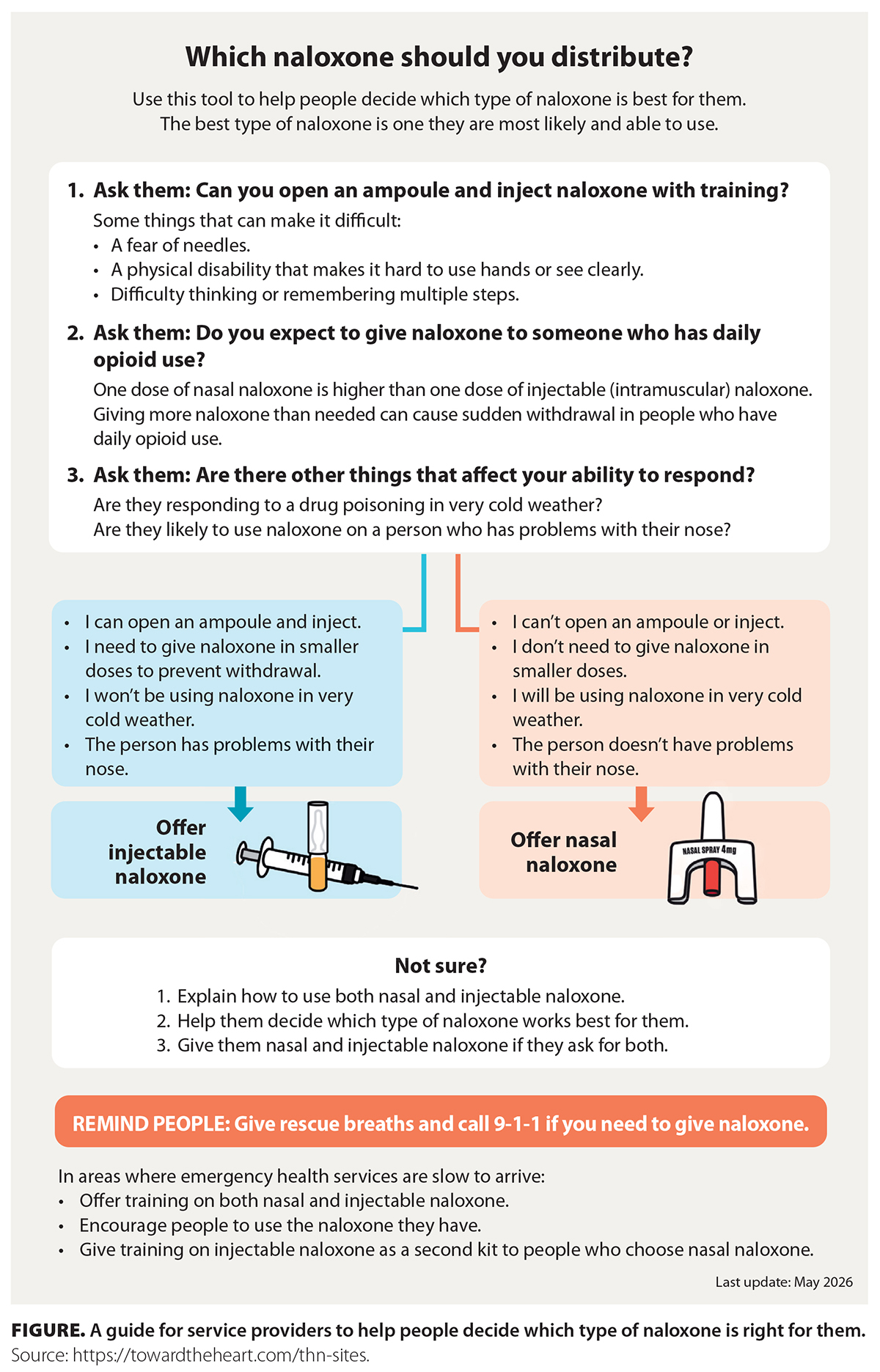
Physicians can help prevent drug poisoning deaths by educating their patients and staff on how to recognize and respond to drug poisonings with naloxone and rescue breaths, distributing naloxone or supporting patients in finding a distribution site on Toward the Heart, and helping patients determine which naloxone formulation best meets their needs [Figure].
Reviewing the advantages and limitations of each formulation can help patients identify the option that best meets their needs. For some individuals, having access to both formulations may be beneficial. Ultimately, the best naloxone is the one that will be used.
—Christie Wall, MPH
Policy Lead, Harm Reduction and Substance Use Services, BCCDC
—Dylan Griffith
Professionals for Ethical Engagement of Peers
—Sierra Williams, MPH
Public Health Manager, Harm Reduction and Substance Use Services, BCCDC
—Sammy Iammarino, RN, MN
Senior Practice Lead, Harm Reduction and Substance Use Services, BCCDC
—Alexis Crabtree, MD, MPH, PhD, CCFP, FRCPC
Public Health Physician, BCCDC
hidden
This article is the opinion of the BC Centre for Disease Control and has not been peer reviewed by the BCMJ Editorial Board.

This work is licensed under a Creative Commons Attribution-NonCommercial-NoDerivatives 4.0 International License.
References
1. BC Centre for Disease Control. Harm reduction and medically supported treatment saves lives: Drug poisoning death events prevented from 2019-2025. Updated September 2025. Accessed 19 June 2026. www.bccdc.ca/Health-Professionals-Site/Documents/Harm-Reduction-Reports/Harm_Reduction_Saves_Lives_Infographic_Sep2025.pdf.
2. Ferguson M, Adams A, Elton-Marshall T, et al. Canadian Take Home Naloxone program guidance. Vancouver, BC: Canadian Research Initiative in Substance Misuse, 2023. Accessed 16 July 2026. https://crism.ca/wp-content/uploads/2023/08/Canadian-Take-Home-Naloxone-Program-Guidance-Report-for-posting-28-Aug-2023.pdf.
3. Ryan SA, Dunne RB. Pharmacokinetic properties of intranasal and injectable formulations of naloxone for community use: A systematic review. Pain Manag 2018;8:231-245. https://doi.org/10.2217/pmt-2017-0060.
4. Dietze P, Jauncey M, Salmon A, et al. Effect of intranasal vs intramuscular naloxone on opioid overdose: A randomized clinical trial. JAMA Netw Open 2019;2:e1914977. Erratum in: JAMA Netw Open 2020;3:e206593. https://doi.org/10.1001/jamanetworkopen.2019.14977.
5. Ghalayni R, Al Kalaji B, Malik K. From friend to foe: A case of naloxone-induced pulmonary edema. Hosp Pharm 2024;59:407-410. https://doi.org/10.1177/00185787241230074.
6. Moustaqim-Barrette A, Papamihali K, Williams S, et al. Adverse events related to bystander naloxone administration in cases of suspected opioid overdose in British Columbia: An observational study. PLoS One 2021;16:e0259126. https://doi.org/10.1371/journal.pone.0259126.