By: BCMJ Staff
BCMJ 2025 reader survey results
Issue: BCMJ,
vol. 67, No. 9, November 2025,
Pages 334-335 Back Page
Readers expressed a passion for print and an appreciation for local content.
In June 2025, Doctors of BC members (approximately 24 700 active and retired physicians) had the opportunity to complete the 2025 BCMJ reader survey. The BCMJ Editorial Board and staff rely on the survey results to learn what readers value and to receive readers’ ideas for changes and improvements to the journal.
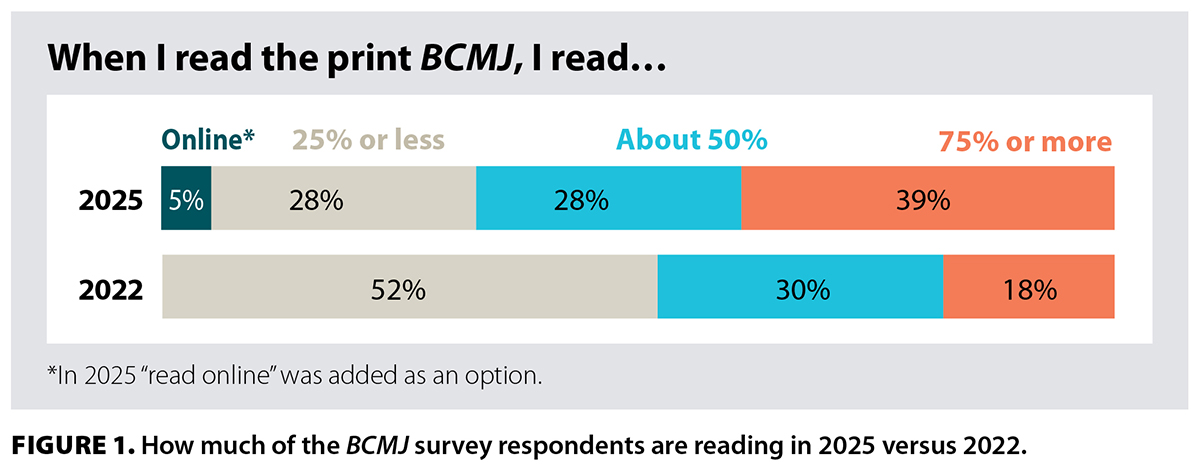
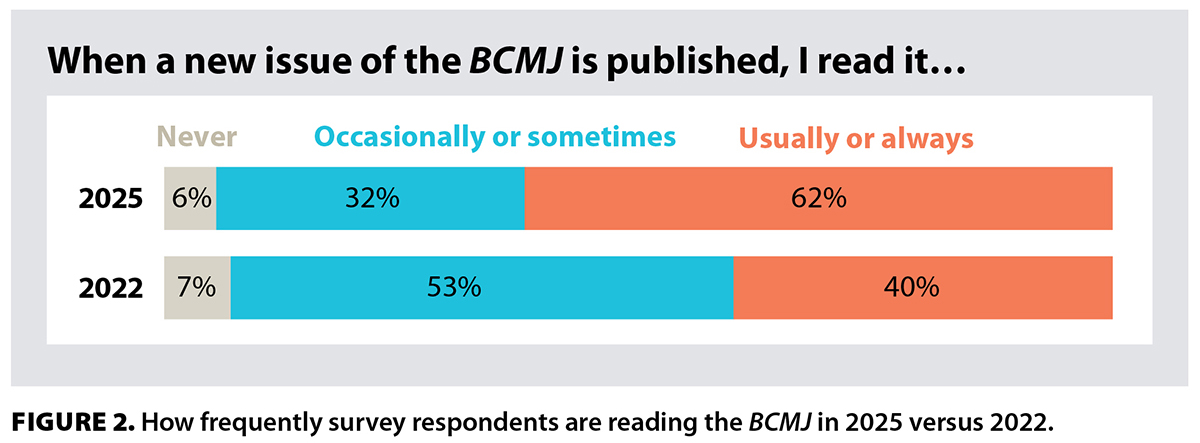
Surveys are conducted every 3 to 5 years, and in every survey since 2002, respondents have expressed that the BCMJ is an important forum for physicians to learn about what’s happening in medicine in BC. This year, when readers were asked to rank the most important features of the journal, this aspect was the winner by a landslide. The survey also showed a remarkable trend in increased loyalty to the publication. Members are reading more of the BCMJ now than they have in the past: the percentage who read between 50% and 100% of an issue has gone up from 48% in 2022 to 67% in 2025 [Figure 1]. Additionally, respondents are reading the journal more frequently: 62% of members responded that they “always” or “usually” read the BCMJ, compared with 40% in 2022 [Figure 2].
Print remains popular
Support for print has been another consistent trend over the years. In her editorial in this issue, BCMJ Editor-in-Chief Dr Caitlin Dunne offers her theories about why this may be the case. This year, 83% of respondents said they preferred to read the journal in print rather than online (vs 82% in 2022). Of the 17% who read online, the majority tended to be younger: 36% were under 35 years of age, and 26% were between 35 and 44 years of age. Conversely, younger respondents were least likely to continue reading the BCMJ if it were available only online. Only 16% of respondents under 35 years of age strongly agreed that they would read an online-only journal, as opposed to 31% of respondents who were 65 years of age or older.
Favorite things
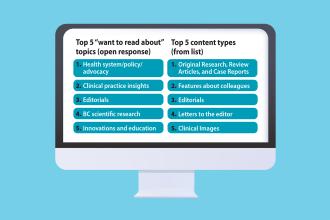
Hundreds of survey respondents (n = 441) also shared their candid feelings about the BCMJ, and those comments were organized into themes to bring trends to the surface. Respondents expressed appreciation for the journal’s BC focus (27%), local updates (16%), and provincial/regional content (6%). Certain categories of content emerged as clear favorites: practice updates and guidelines (13%) and medical research and clinical articles (10%). Respondents also valued being part of the journal’s physician community (15%) and recognized the journal’s aesthetic appeal (11%). Two percent of the comments about respondents’ “favorite things” had a negative sentiment.
Ideas for improvement
The journal also welcomed constructive feedback. Of the 298 respondents who offered ideas for how the journal could improve, 7% suggested the journal should reduce its political correctness, 5% critiqued the journal’s diversity of perspectives, and 4% suggested the journal should reassess its mission. In a similar vein, 5% suggested that clinical content be enhanced, 5% offered criticisms of the journal’s editorial decisions, and 3% suggested improvements to the journal’s peer-review standards. The journal’s format and delivery emerged as another theme in the comments, with the most frequently arising request being to “keep print” (18%), while 4% of respondents supported a switch to online only, and 3% requested improvements to the accessibility of the journal’s online content. We report on very low numbers (in the 3% to 7% range) out of respect for our readers and for the sake of transparency. Some of the suggestions for improvement are already under consideration as part of the journal’s ongoing work toward becoming an indexed publication. Twenty-seven percent of respondents reported that they had no suggestions for improvement.
New features
When asked if the BCMJ should add any new features (from a list of options), respondents were most interested in the journal becoming indexed (408 votes) and adding an app (404 votes), and less enthusiastic about video (244 votes) and audio (210 votes) features. In response to another question, many readers expressed an interest in receiving certified self-learning credits for reading the BCMJ (50% of respondents agreed or strongly agreed, and 33% were neutral).
The BCMJ Editorial Board and staff thank everyone who provided feedback in the 2025 reader survey. Keep an eye out for updates about changes and improvements to the journal based on your feedback.
Survey methodology
Online survey, 795 responses
Margin of error: +/− 3.42%
Response rate: 3%
Conducted by TWI Surveys, 9 June to 4 July 2025
hidden
 |
| This work is licensed under a Creative Commons Attribution-NonCommercial-NoDerivatives 4.0 International License. |