By: Miini Minami Teng, MD, MPH, MOT [2] Sarah B. Henderson, PhD [3] David A. McVea, MD, PhD [4] Rashmi Chadha, MBChB, MScCH, CCFP (AM), FASAM [5] Malcolm Maclure, ScD [6] Caroline Stigant, MD [7] Ilona Hale, MD, FCFPC [8] Tim Takaro, MD, MPH, MS [9] Videsh Kapoor, MD, CCFP, FCFP [10]
As climate-related exposures increasingly shape health, routine environmental history taking can help clinicians deliver more precise, preventive, and responsive care.
Climate change and environmental determinants of health
Climate change and related environmental determinants are increasingly recognized as major drivers of physical and mental health.[1,2] Exposure to extreme weather, wildfire and smoke, flooding, drought, environmental pollution, and biodiversity loss have all been associated with adverse outcomes. In British Columbia, the 2021 heat dome led to 619 heat-related deaths in a single week, underscoring the urgency of incorporating environmental considerations into clinical care.[3] Seasonal wildfires expose people to high levels of fine particulate matter and other pollutants, worsening respiratory and cardiovascular disease[4] and contributing to increased mortality,[5] such that recurrent wildfire smoke exposure has been associated with an average loss of about 6 weeks of life expectancy in BC.[6] Beyond direct exposures, climate-related events can also harm health through evacuation and displacement, landslides and service disruptions, and shifting infectious disease patterns, with impacts felt inequitably across communities depending on geography, income, baseline health, gender, and other factors.[7,8]
Certain populations are particularly susceptible to environmental exposures, including infants, children, pregnant people, older adults, those with chronic physical and mental health conditions, and those living in poverty.[9] For example, wildfire smoke exposure during pregnancy has been associated with lower birth weight,[10] and extreme heat increases the risk of preterm birth.[11] Children have higher air pollution exposure than adults on a per mass basis due to higher ventilation rates and more time spent outdoors.[12] Susceptibility is heightened among children with asthma, the most prevalent chronic childhood disease, increasing their risk of exacerbations during smoky summer months.[13] Older adults, particularly those without access to air conditioning, with limited mobility, and with heat intolerance from medications, are at higher risk of heat-related illness.[14] From a health equity perspective, those living in poverty and those with mental illness were disproportionately affected by the 2021 heat dome, and they are consistently most affected by other environmental exposures.[15,16]
Considering environmental history as part of clinical history
Integrating environmental questions into clinical history can lead to more refined diagnoses, uncovering links between symptoms and environmental exposures. Such refinement may reduce the use of other, more costly diagnostics.[17] Headaches or fatigue could relate to poor indoor environmental quality.[18] Mental health conditions may worsen during climate-related disasters.[19] Chronic kidney disease can progress more rapidly with higher ambient heat exposure.[20] In addition, clinicians sharing their concerns about climate change and its health impacts can strengthen patient relationships and empower preparedness.[21] Physicians play a key role in shaping public perceptions about climate change, often exerting greater influence than other sources.[22]
How to incorporate environmental history
Health care professionals develop deep understandings of the communities they serve. Knowledge of traditional food sources, sacred places, regional industry and employment, and natural features is key to tailoring an informed environmental history and therapeutic plan. Several tools support environmental history taking in clinical practice. The mnemonic CH2OPD2 (community, home, hobbies, occupation, personal habits, diet, and drugs) is a tool to identify a patient’s history of exposures to potentially toxic environmental contaminants.[23] Pediatric-specific resources, like the World Health Organization’s Paediatric Environmental History tool, help clinicians screen pediatric patients for air quality, heat, and allergens.[24] For disaster-specific readiness, the Climate Resilience for Frontline Clinics Toolkit from the Center for Climate, Health, and the Global Environment at the Harvard T.H. Chan School of Public Health offers heat- and wildfire-focused tools for vulnerable populations.[25] The adaptation presented here synthesizes these approaches into practical, accessible clinical prompts that can be used at the point of care.
Once a patient’s presenting problem has been established, clinicians may want to elicit an environmental history of the presenting illness. For example, ask patients if there are any pollution sources near them, such as factories, highways, or other industrial activities; whether their symptoms are affected by the weather, air quality, or wildfire smoke; and about their occupations and job tasks. Answers to these questions can uncover associations between exposures and illness.
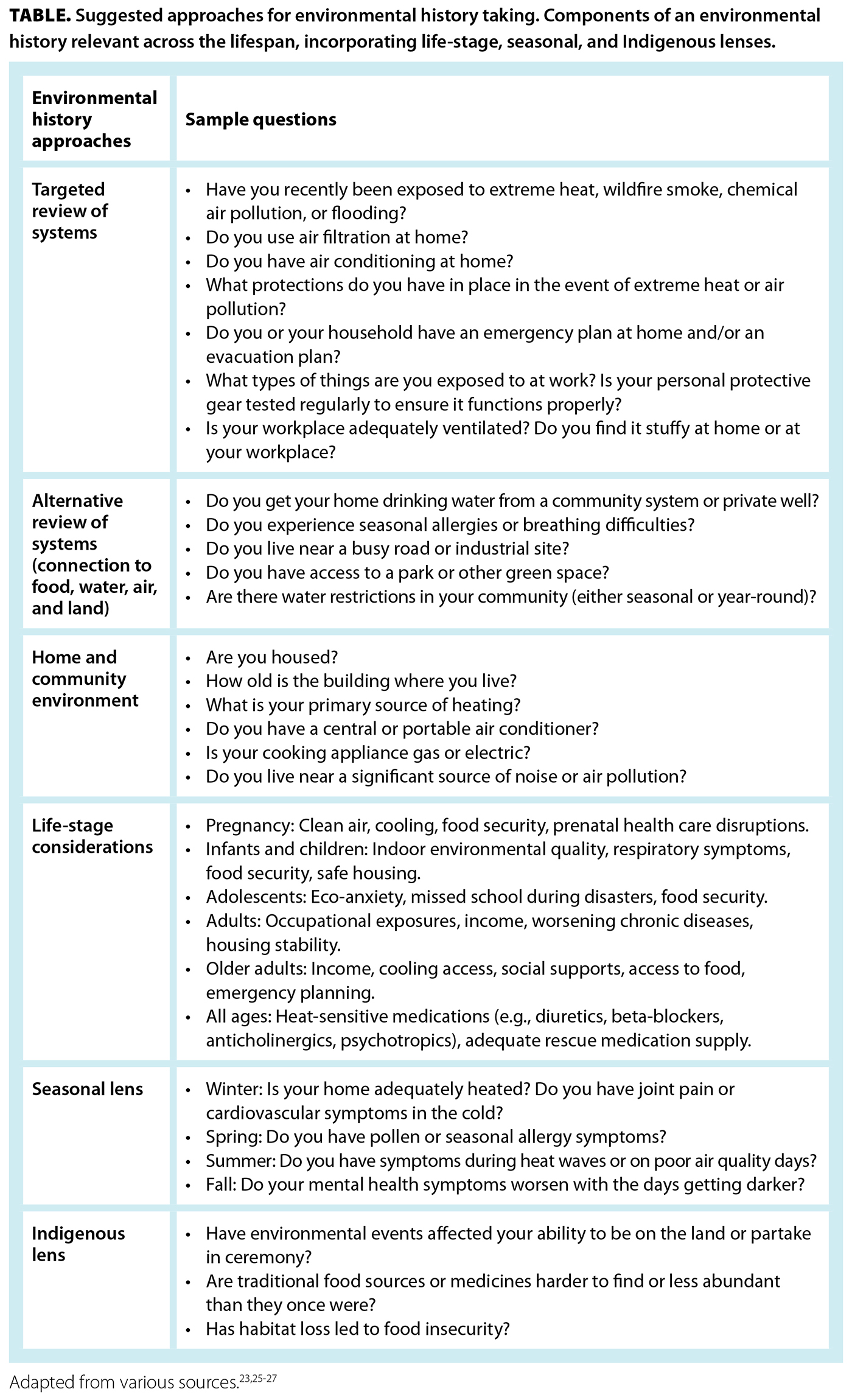
The Table [19] provides several adaptable approaches for incorporating an environmental context into clinical history taking.[23,25-27] Clinicians may use a brief targeted environmental review of systems when time is limited or apply life-stage, seasonal, and community-context lenses to guide more anticipatory or equity-oriented screening.
 [19]
[19]
The clinical impression should include items from the history that are pertinent to the illness(es) being treated. Environmental considerations should be integrated into the treatment plan if relevant, addressing factors such as exposure to pollutants, heating and cooling methods, ventilation, and water sources that may impact the patient’s health.
Resources for BC clinicians
The BC Centre for Disease Control offers clinical guidance tool kits for extreme heat and wildfire smoke exposure, along with tips for effective communication,[28,29] public resources about wildfire smoke and extreme heat, and a guide to building do-it-yourself air cleaners. The Air Quality Health Index provides hourly updates about current conditions,[30] and the national AQmap [20] integrates data from a growing network of low-cost air quality sensors. PreparedBC has multiple resources for disaster preparedness, including for extreme heat events, that can be shared with patients.[31] Additionally, environmental recommendations can be supported through formal prescribing pathways. For instance, air filtration or cooling supports can be prescribed where indicated,[32] and clinicians can use programs such as PaRx to prescribe access passes to public parks in BC, facilitating equitable access to nature-based health benefits.[33]
Conclusions
Environmental history taking is an emerging, resource-conscious approach that may improve diagnostic clarity and preventive care, particularly in the context of extreme environmental exposures and climate-related emergencies. When included with a robust occupational and social history, the clinician can be more targeted in using diagnostic tests and gain insights into disease mechanisms to improve treatment. While more research is needed to quantify their cost-effectiveness, using frameworks like the BC Lifetime Prevention Schedule or time-needed-to-treat models,[34,35] environmental histories offer a structured way to identify potentially modifiable exposure risks without requiring additional tests or equipment. Incorporating these conversations into clinical care can strengthen relationship-based care and empower patients to prepare for and mitigate environmental health risks in the changing climate.
Competing interests
None declared.
hidden
This article has been peer reviewed.
 [21]
[21]
This work is licensed under a Creative Commons Attribution-NonCommercial-NoDerivatives 4.0 International License [21].
References
1. Robinson JM, Breed AC, Camargo A, et al. Biodiversity and human health: A scoping review and examples of underrepresented linkages. Environ Res 2024;246:118115. https://doi.org/10.1016/j.envres.2024.118115 [22].
2. Fuller R, Landrigan PJ, Balakrishnan K, et al. Pollution and health: A progress update. Lancet Planet Health 2022;6(6):e535-e547. https://doi.org/10.1016/S2542-5196(22)00090-0 [23].
3. Clayton S. Climate change and mental health. Curr Environ Health Rep 2021;8:1-6. https://doi.org/10.1007/s40572-020-00303-3 [24].
4. Etzel RA, Weimann E, Homer C, et al. Climate change impacts on health across the life course. J Glob Health 2024;14:03018. https://doi.org/10.7189/jogh.14.03018 [25].
5. Qiu M, Li J, Gould CF, et al. Wildfire smoke exposure and mortality burden in the USA under climate change. Nature 2025;647:935-943. https://doi.org/10.1038/s41586-025-09611-w [26].
6. Matz CJ, Egyed M, Wang X, et al. Health impact analysis of wildfire smoke-PM2.5 in Canada (2019–2023). GeoHealth 2026;10:e2025GH001565. https://doi.org/10.1029/2025GH001565 [27].
7. Cissé G, McLeman R, Adams H, et al. Health, wellbeing, and the changing structure of communities. In: Climate change 2022: Impacts, adaptation and vulnerability. Contribution of Working Group II to the sixth assessment report of the Intergovernmental Panel on Climate Change. Pörtner H-O, Roberts DC, Tignor M, et al., editors. Cambridge, UK, and New York, NY: Cambridge University Press; 2023. pp. 1041-1170. https://doi.org/10.1017/9781009325844.009 [28].
8. World Health Organization. Climate change [fact sheet]. 12 October 2023. Accessed 25 March 2026. www.who.int/news-room/fact-sheets/detail/climate-change-and-health? [29].
9. McLean KE, Lee MJ, Coker ES, Henderson SB. A population-based case-control analysis of risk factors associated with mortality during the 2021 western North American heat dome: Focus on chronic conditions and social vulnerability. Environ Res: Health 2024;2:035010. https://doi.org/10.1088/2752-5309/ad5eac [30].
10. Basilio E, Chen R, Fernandez AC, et al. Wildfire smoke exposure during pregnancy: A review of potential mechanisms of placental toxicity, impact on obstetric outcomes, and strategies to reduce exposure. Int J Environ Res Public Health 2022;19:13727. https://doi.org/10.3390/ijerph192113727 [31].
11. Anastasopolos AT, Rouleau M. Health impacts of air pollution in Canada: Recent findings on mortality, morbidity, and monetized costs by transportation, industry, and residential sectors. Health Canada. 28 September 2023. Accessed 13 January 2026. https://ncceh.ca/sites/default/files/2023-09/NCCEH_Webinar_%2028%20Sept%202023%20-%20Health%20Canada_Sector%20Health%20Impacts.pdf [32].
12. Serebrisky D, Wiznia A. Pediatric asthma: A global epidemic. Ann Glob Health 2019;85. https://doi.org/10.5334/aogh.2416 [33].
13. Fernández ACG, Basilio E, Benmarhnia T, et al. Retrospective analysis of wildfire smoke exposure and birth weight outcomes in the San Francisco Bay Area of California. Environ Res Health 2023;1:025009. https://doi.org/10.1088/2752-5309/acd5f5 [34].
14. United States Environmental Protection Agency. Heat island effect. Updated 18 November 2025. Accessed 14 January 2026. www.epa.gov/heatislands [35].
15. Chang CC, Lin BB, Feng X, et al. A lower connection to nature is related to lower mental health benefits from nature contact. Sci Rep 2024;14:6705. https://doi.org/10.1038/s41598-024-56968-5 [36].
16. Henderson SB, McLean KE, Lee MJ, Kosatsky T. Analysis of community deaths during the catastrophic 2021 heat dome: Early evidence to inform the public health response during subsequent events in Greater Vancouver, Canada. Environ Epidemiol 2022;6:e189. https://doi.org/10.1097/EE9.0000000000000189 [37].
17. Ghotra SS, Champendal M, Flaction L, et al. Approaches to reduce medical imaging departments’ environmental impact: A scoping review. Radiography (Lond) 2024;30(Suppl 1):108-116. https://doi.org/10.1016/j.radi.2024.08.002 [38].
18. Tietjen GE, Khubchandani J, Ghosh S, et al. Headache symptoms and indoor environmental parameters: Results from the EPA BASE study. Ann Indian Acad Neurol 2012;15(Suppl 1):S95-S99. https://doi.org/10.4103/0972-2327.100029 [39].
19. Dodds J. The psychology of climate anxiety. BJPsych Bull 2021;45:222-226. https://doi.org/10.1192/bjb.2021.18 [40].
20. Zhang Z, Heerspink HJL, Chertow GM, et al. Ambient heat exposure and kidney function in patients with chronic kidney disease: A post-hoc analysis of the DAPA-CKD trial. Lancet Planet Health 2024;8:e225-e233. https://doi.org/10.1016/S2542-5196(24)00026-3 [41].
21. Tarver CA, Macpherson CC. Medicine in a warming world: The physician’s role in climate action. Wiley Interdiscip Rev Clim Change 2025;16:e70010. https://doi.org/10.1002/wcc.70010 [42].
22. Boland TM, Temte JL. Family medicine patient and physician attitudes toward climate change and health in Wisconsin. Wilderness Environ Med 2019;30:386-393.
23. Marshall L, Weir E, Abelsohn A, Sanborn MD. Identifying and managing adverse environmental health effects: 1. Taking an exposure history. CMAJ 2002;166:1049-1055.
24. World Health Organization. The paediatric environmental history: A tool for health care providers: Training for health care providers. 3rd ed. Children’s health and the environment: WHO training package for the health sector. 24 June 2023. Accessed 15 January 2026. https://iris.who.int/bitstream/handle/10665/372855/WHO-HEP-ECH-CHE-23.12-eng.pdf [43].
25. Center for Climate, Health, and the Global Environment at the Harvard T.H. Chan School of Public Health. Climate resilience for frontline clinics toolkit. 26 September 2024. Accessed 14 January 2026. https://hsph.harvard.edu/research/climate-health-c-change/outreach/building-climate-resilient-healthcare-clinics/climate-resilience-for-frontline-clinics/ [44].
26. ten Tusscher GW, Leijs MM, Koppe JG. Paediatric environmental health history taking: Why bother? Acta Paediatr Suppl 2006;95:13-17. https://doi.org/10.1080/08035320600882249 [45].
27. National Multiple Sclerosis Society. Heat sensitivity with multiple sclerosis. Accessed 14 January 2026. www.nationalmssociety.org/managing-ms/living-with-ms/diet-exercise-and-healthy-behaviors/heat-temperature [46].
28. BC Centre for Disease Control. Environmental health risks. Updated 3 July 2024. Accessed 14 January 2026. www.bccdc.ca/health-professionals/clinical-resources/environmental-health-risks [47].
29. BC Centre for Disease Control. Wildfire smoke. Accessed 14 January 2026. www.bccdc.ca/health-info/prevention-public-health/wildfire-smoke [48].
30. Government of Canada. Air quality health index. Modified 9 June 2025. Accessed 14 January 2026. www.canada.ca/en/environment-climate-change/services/air-quality-health-index.html [49].
31. PreparedBC. Extreme heat preparedness guide. Updated February 2025. Accessed 14 January 2026. www2.gov.bc.ca/assets/gov/public-safety-and-emergency-services/emergency-preparedness-response-recovery/embc/preparedbc/preparedbc-guides/preparedbc_extreme_heat_guide.pdf [50].
32. Vancouver Coastal Health Research Institute. Air filter rebates for people in BC with asthma. 23 February 2024. Accessed 13 February 2026. www.vchri.ca/stories/2024/02/23/air-filter-rebates-people-bc-asthma [51].
33. Government of Canada. Lines 33099 and 33199 – Eligible medical expenses you can claim on your tax return. Modified 21 January 2025. Accessed 15 January 2026. www.canada.ca/en/revenue-agency/services/tax/individuals/topics/about-your-tax-return/tax-return/completing-a-tax-return/deductions-credits-expenses/lines-33099-33199-eligible-medical-expenses-you-claim-on-your-tax-return.html [52].
34. Government of British Columbia. Lifetime prevention schedule. 24 January 2025. Accessed 1 April 2026. www2.gov.bc.ca/gov/content/health/about-bc-s-health-care-system/health-priorities/lifetime-prevention [53].
35. Johansson M, Guyatt G, Montori V. Guidelines should consider clinicians’ time needed to treat. BMJ 2023;380:e072953. https://doi.org/10.1136/bmj-2022-072953 [54].
hidden
Dr Teng is a second-year resident in the University of British Columbia Public Health and Preventive Medicine Including Family Medicine Residency Program. She is also a clinical assistant professor in the UBC Department of Occupational Science and Occupational Therapy. Dr Henderson is scientific director of environmental health at the BC Centre for Disease Control and the National Collaborating Centre for Environmental Health. She oversees a broad program of applied research, surveillance, knowledge translation, and training to support evidence-based environmental public health policies, programs, and practices in BC and across Canada. Dr McVea is a senior scientist and public health physician at the BCCDC, specializing in environmental health. He is also a clinical assistant professor in the UBC School of Population and Public Health. Dr Chadha is an addiction physician at Vancouver Coastal Health and a clinical associate professor in the UBC Department of Family Practice. She is the planetary health clinician engagement lead for VCH, is co-chair of Health Quality BC’s Provincial Sustainable Clinical Services Working Group, and represents UBC on the Association of Faculties of Medicine of Canada’s Committee on Planetary Health. Dr Maclure is a professor emeritus and former BC chair in patient safety research in the Department of Anesthesiology, Pharmacology and Therapeutics in the UBC Faculty of Medicine. Dr Stigant is a nephrologist at Island Health. She created and delivers the UBC undergraduate medical lecture “The Climate Crisis, Planetary Health, and Medical Practice.” She is also the medical lead of BC Renal’s Planetary Health Working Group, chair of the Canadian Society of Nephrology’s Sustainable Nephrology Action Planning Committee, and vice chair of the International Society of Nephrology’s GREEN-K Steering Committee. Dr Hale is a family physician and clinical assistant professor in the UBC Department of Family Practice. She is also the medical director for climate change and sustainability at Interior Health. Dr Takaro is a physician-scientist and planetary health lead for the new Simon Fraser University School of Medicine. Dr Kapoor is a clinical assistant professor in the UBC Department of Family Practice and a family physician practising in Vancouver. She is the director of the UBC Faculty of Medicine Family Practice Postgraduate Program’s Enhanced Skills Program in Global Health and the global health and planetary health theme lead in the UBC Doctor of Medicine Undergraduate Program.
Corresponding author: Dr Miini Minami Teng, miini.teng@ubc.ca [55].