Sustainability in health care has become a critical global issue, with health care waste management at its forefront. In particular, the use of disposable and single-use materials contributes to an average of 3.77 kg/bed/day of waste generated in North America,[1] and an estimated 5 million tonnes/year of solid waste generated globally,[2] with evidence indicating an upward trend in health care waste.[3]
As advances in science, technology, and medicine contribute to improved life expectancy, a rapidly aging population will require more health care facilities and services, which will generate more waste.[4] Another contributor to the increase in medical waste is the shift in developed nations away from multi-use medical devices to single-use devices for the benefits of infection control, convenience, and cost savings.[3]
Single-use sterile items are frequently discarded after being opened because the equipment is the incorrect size or the item is inappropriate for the planned procedure. Furthermore, there are often discrepancies between anticipated equipment needs and actual equipment use, which leads to items reaching expiration dates prior to use.
Our goals, as members of the Royal Inland Hospital (RIH) Environmental Sustainability Committee and the Rae Fawcett Simulation Centre (RFSC) at RIH, were to reduce our hospital’s health care–associated landfill waste and decrease procurement and waste disposal costs through a hospital-wide coordination of equipment donations for use in our on-site simulation centre.
Prior to this initiative, our simulation centre relied heavily on the generous support of the RIH and Kelowna General Hospital Foundation donors to purchase new training equipment. Simulation training does not require new, sterile, single-use equipment, and much of it can be used multiple times before being discarded.
Initiative description
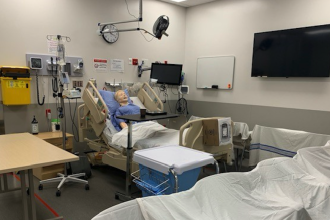
Implemented June through August 2025, this project aimed to reduce waste output and procurement costs in the Rae Fawcett Simulation Centre through the donation of expired or unused equipment from targeted hospital departments, thereby reducing the purchase of new equipment for use in the simulation centre while simultaneously lowering our solid-waste footprint, waste disposal costs, and equipment procurement costs. This has the added benefit of providing simulation participants with hand-on experience with real equipment seen in clinical practice.
The Rae Fawcett Simulation Centre supports simulation learning sessions for undergraduate and postgraduate learners, Interior Health Authority staff, physicians, nurses, respiratory therapists, and other partnered health care organizations and professionals. The centre also supports Interior Health rural hospitals and community sites throughout the northern Thompson Okanagan region. The centre is part of Interior Health/University of British Columbia’s simulation program, which is accredited by the Royal College of Physicians and Surgeons of Canada and is made up of three other fixed simulation centres in Kelowna, Penticton, and Trail.
The RIH Sustainability Committee and the centre’s simulation coordinator selected departments to target for donations of expired and/or opened, unused equipment useful in simulation training. Posters were distributed to advertise the initiative, and lists of the desired equipment were circulated to key partners, including the emergency and intensive care educators, as well as the Logistics Department. The posters and lists detailed how to arrange for pickup of the equipment.
The RIH Logistics Department maintains a location used to divert some expired equipment to staff initiatives, such as the Africa project, which repurposes expired operating room supplies to bring to Africa. A similar agreement previously existed in Trail, where the logistics staff diverted their expired equipment to the local simulation centre. Building on this, relationships were created between logistics staff, committee members, and the RFSC to expand the scope of the Logistics Department location to include this initiative. The simulation coordinator would review new expired equipment donations for suitable items for simulation-based training.
Donations were collected monthly, with item weight and cost savings tracked in a spreadsheet. Item costs were determined based on their purchase prices. RIH waste disposal is a weight-based cost, currently at $0.22/kg. The savings associated with waste diversion were also tracked.
When there were excess donations of certain equipment, the simulation coordinator shared those donations with the other simulation centres within Interior Health. The Figure [2] shows the equipment donation workflow.
Results
Diverting expired or unused equipment to the simulation centre has significantly supported our waste reduction efforts, generated cost savings, and enabled simulation participants to gain hands-on experience with the real equipment that they will likely encounter in clinical practice.
Since its inception, the initiative has diverted nearly 34 kg of expired or unused equipment and has generated savings of more than $5000 [Table [3]]. These results are particularly significant considering the project was operational for 3 months and involved only two departments in the hospital.
June 2025 saw the highest volume of donations, which coincided with the launch of our targeted advertising campaign. This suggests that strategic promotion played a role in increased engagement and participation. Further investment in advertising and enhancing relationships with key partners could yield additional positive outcomes.
Limitations
Several limitations should be acknowledged when interpreting the outcomes of the initiative. First, the project operated for a relatively short time, which may not fully capture long-term trends or the sustained impact of the program. Notable data gaps remain, particularly regarding the total hospital disposal costs and the total volume of equipment diverted to staff initiatives, such as the Africa project, as comprehensive figures have not yet been collected. Finally, the analysis is based on a small sample size, involving only two departments, which may limit the generalizability of the findings to the broader hospital setting.
Future potential
Building on these promising results, there is considerable potential to enhance the initiative’s impact by involving more departments at RIH and expanding to additional Interior Health hospitals. By extending the initiative to additional departments, we can encourage greater interdepartmental collaboration and improve coordination of donations.
The Pritchard Simulation Centre at Kelowna General Hospital is currently building relationships to develop a similar diversion project. Additionally, this project and its early results were shared with the BC Simulation Network membership to spark discussion on a provincewide scale. Expanding the donation network would not only increase the volume of equipment diverted but also amplify the cost savings for health authorities, while still providing exceptional simulated learning experiences. Scaling the program will further support institutional sustainability efforts, foster knowledge sharing, and enhance the collective impact across the health authority.
This initiative reinforces the value of implementing low-cost, high-impact sustainability strategies within health care settings, and creating benefits for both hospitals and the environment.
—Jamie Tersago, BSc (Kin)
Fourth-year UBC Medicine Student
—Meghan Tome, MSN, RN
Simulation Coordinator, Interior Health
—Anise Barton, MD
General Surgeon, Perioperative Medical Director, Royal Inland Hospital
Clinical Assistant Professor, Department of Surgery, UBC
References
1. Mol MPG, Zolnikov TR, Neves AC, et al. Healthcare waste generation in hospitals per continent: A systematic review. Environ Sci Pollut Res Int 2022;29:42466-42475. https://doi.org/10.1007/s11356-022-19995-1 [4].
2. Slutzman JE, Bockius H, Gordon IO, et al. Waste audits in healthcare: A systematic review and description of best practices. Waste Manag Res 2023;41:3-17. https://doi.org/10.1177/0734242x221101531 [5].
3. Campion N, Thiel CL, Woods NC, et al. Sustainable healthcare and environmental life-cycle impacts of disposable supplies: A focus on disposable custom packs. J Cleaner Prod 2015;94:46-55. https://doi.org/10.1016/j.jclepro.2015.01.076 [6].
4. Windfeld ES, Brooks MS-L. Medical waste management – A review. J Environ Manage 2015;163:98-108. https://doi.org/10.1016/j.jenvman.2015.08.013 [7].