Related To:
 [6]
[6]
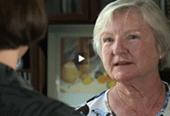
Video from Vancouver Coastal Health: Dorothy's Story [6]
[6]
Video from Vancouver Coastal Health: Dorothy's Story [6]
While hospitalization offers older patients the benefits of high-level care during episodes of acute illness, it also exposes them to the risks of iatrogenic illness (i.e., adverse events) and functional decline.
In Canada over 50% of acute care hospital beds are currently occupied by seniors (persons aged 65 years and older) on any particular day.[1] Moreover, one-third of older persons admitted to acute care will be discharged at a significantly reduced level of functional ability, and most will never recover to their previous level of independence.[2]
While hospitalization offers older patients the benefits of high-level care during episodes of acute illness, it also exposes them to the risks of iatrogenic illness (i.e., adverse events) and functional decline. Without swift and appropriate clinical interventions, the general functional ability of older patients can decline rapidly.
The repercussions can be costly: for hospitals, the cost of avoidable complications associated with hospital care, prolonged lengths of stay, and access and flow issues in the system due to bed shortages; for patients, recurrent admissions, premature admission to residential care homes, and permanent loss of independence and diminished quality of life.
Based on Canadian census data, Canada is undergoing an unprecedented demographic shift: in 2000, 12.5% of the population of British Columbia was aged 65 years, and by 2026 it is estimated to increase to 21%. Aging is thus at the forefront of the health and social policy agenda. Patients aged 65 and older now account for 37% of inpatient discharges and over 50% of inpatient days.[3]
Despite the high utilization of the health care system by older adults, the care that many frail older adults receive is ineffective and often harmful because we are unable to assess the risk-benefit of different treatment options. We believe that both patient and hospital factors are related to the risk of adverse outcomes.
Part of the formal insouciance about hospital care of older adults arises because physical and mental deterioration is seen as inevitable and thus neglected. In fact, older adults have an innate capacity for rehabilitation;[4] at almost any given level of frailty, some improvement remains possible.[5]
In a study by Lang and colleagues, researchers attempted to identify markers of prolonged hospital stay in patients with dementia. Multifactor analysis demonstrated that demographic variables had no influence on the length of stay, while diagnosis of delirium, walking difficulties, and report by the informal caregiver of moderate or severe burden or low caregiver social quality-of-life score were identified as early markers for prolonged hospital stays.
Other variables in the analysis included level of disability in regard to activities of daily living, gender, age, living situation, marital status, type of caregiver, mood disorders, gait and balance disorders, malnutrition risk, bedridden status, pressure sores risk, incontinence, and comorbidity index level.[6]
Researchers suggested that delirium may increase hospital stay by contributing to a functional decline and by preventing the patient from participating in rehabilitation. Patients who develop delirium are also more likely to be transferred to a nursing home and therefore may remain in hospital longer as they wait for a bed to become available.[6]
In the study walking difficulties were also associated with increased length of stay. Prevention or early detection and management of delirium, as well as early rehabilitation and mobilization, may reduce length of stay.
During hospital stays, fasting in connection with certain tests, inadequate help with feeding, and the anorexic effect of certain types of medications may lead to decreased protein and caloric intake. This may further contribute to muscle loss and decreased mobility and function. Therefore, monitoring caloric intake and weight may help to maintain strength and mobility.[6]
As well, the increased burden of care on caregivers was identified as a marker of prolonged hospital stays. This burden of care may contribute to increased length of stay in a variety of ways. It may lead to more frequent crisis situations requiring visits to the emergency department and hospital admissions. It may also make caregivers more reluctant toward patient discharge.
A multidisciplinary approach to care of patients with dementia in the community, involving the primary care physician, nurses, and care aids that can visit the patient at home, as well as access to respite programs, is recommended to decrease the burden of care on family members. Communication between the hospital care team and community care teams may also facilitate the discharge process.[6]
To say that it is “timely” to focus on the implementation of interventions for older patients in the acute care setting is a huge understatement due to the increasing number of seniors in the general population and utilization rates of hospital-based services.
On the eve of a demographic shift, the appropriateness and quality of hospital care for older adults remains grossly inadequate. We cannot accept that loss of independence following acute care is just a part of normal aging. The common cascade of both physical and cognitive decline is frequently preventable.
However, an extensively researched strategy will be needed to provide evidence to challenge deeply ingrained traditional ways of providing care.[7] At no other point in the history of Canada has there ever been such an urgent demographic imperative to step up to the challenge of improving acute care for older adults.
Dorothy’s Story, as told by a daughter, puts a face to the challenge of setting appropriate goals of care. Video online at bcmj.org. www.vch.ca/your_health/seniors/ [6].
—Janet E. McElhaney, MD, FRCPC, FACP
Co-chair, Geriatrics and Palliative Care Committee
—Sonia Murray, UBC Medical School, Class 2012
—Martha Donnelly, MD, CCFP, FRCPC
Associate Professor at UBC
—David Thompson, Corporate Director, Seniors Care, Providence Health Care
This article is the opinion of the Council on Health Promotion and has not been peer reviewed by the BCMJ Editorial Board.
1. Canadian Institute for Health Information. CIHI Discharge Abstract Database, 2009-2010. Accessed 7 February 2011. http://secure.cihi.ca/cihiweb/products/DAD%200809%20Reabstraction%20Study%20Report_final_EN.pdf [15].
2. Covinsky KE, Newcomer R. Patient and caregiver characteristics associated with depression in caregivers of patients with dementia. J Gen Intern Med 2003;18:1006-1014.
3. Siu AL, Spragens LH. The ironic business case for chronic care in the acute care setting. Health Aff (Millwood) 2009;28:113-125.
4. Strawbridge WJ, Cohen RD. Successful aging: Predictors and associated activities. Am J Epidemiol 1996;144:135-141.
5. Mitnitski A, Rockwood K. Decrease in the relative heterogeneity of health with age: A cross-national comparison. Mech Ageing Dev 2006;127:70-72.
6. Lang PO, Zekry D, Michel JP, et al. Early markers of prolonged hospital stay in demented inpatients: a multicentre and prospective study. J Nutrition Health Aging 2010;14:141-147.
7. Rockwood K. Capacity, population aging and professionalism. CMAJ 2006;174:1689,1691.
Links
[1] https://bcmj.org/cover/march-2011
[2] https://bcmj.org/author/janet-mcelhaney-md
[3] https://bcmj.org/author/sonia-murray
[4] https://bcmj.org/author/martha-lou-donnelly-md-ccfp-frcpc
[5] https://bcmj.org/author/david-thompson-md-frcpc
[6] http://www.vch.ca/your_health/seniors/
[7] https://bcmj.org/node/4069
[8] https://bcmj.org/sites/default/files/BCMJ_53_Vol2_cohp.pdf
[9] https://bcmj.org/print/cohp/prevention-acute-care-seniors
[10] https://bcmj.org/printmail/cohp/prevention-acute-care-seniors
[11] http://www.facebook.com/share.php?u=https://bcmj.org/print/cohp/prevention-acute-care-seniors&via=BCMedicalJrnl&tw_p=tweetbutton
[12] https://twitter.com/intent/tweet?text=Prevention in acute care for seniors&url=https://bcmj.org/print/cohp/prevention-acute-care-seniors&via=BCMedicalJrnl&tw_p=tweetbutton&via=BCMedicalJrnl&tw_p=tweetbutton
[13] https://www.linkedin.com/sharing/share-offsite/?url=https://bcmj.org/print/cohp/prevention-acute-care-seniors&via=BCMedicalJrnl&tw_p=tweetbutton
[14] https://bcmj.org/javascript%3A%3B
[15] http://secure.cihi.ca/cihiweb/products/DAD%200809%20Reabstraction%20Study%20Report_final_EN.pdf
[16] https://bcmj.org/modal_forms/nojs/webform/176
[17] https://bcmj.org/%3Finline%3Dtrue%23citationpop