“We cannot reconcile until the truths are talked about. Until the truths are dealt with. What are the truths that have happened to our people over the last 150 years?! Well, we don’t want to talk about it because it’s not a good subject. But it is one that has to be done.”[1]
— Debra Sparrow, Musqueam weaver, artist, and Knowledge Keeper
ACKNOWLEDGMENT
We acknowledge the Title and Rights of BC First Nations who have cared for and nurtured the lands and waters for all time, including the xʷməθkʷəy̓əm (Musqueam) Nation, Sḵwx̱wú7mesh Úxwumixw (Squamish Nation), and səlilwətaɬ (Tsleil-Waututh Nation), on whose unceded, occupied, and ancestral territory the BC Centre for Disease Control is located. We recognize the Musqueam, Squamish, and Tsleil-Waututh Nations’ historical and ongoing relationships with these lands that continue to this day.
As a provincial organization, we recognize and acknowledge the inherent Title and Rights of BC First Nations, whose territories stretch to every inch of the lands colonially known as British Columbia.
We also recognize that BC is home to many First Nations, Inuit, and Métis people from homelands elsewhere in Canada and having distinct rights, including rights to health, that are upheld in international, national, and provincial laws.
As Canada prepares to mark 10 years since the Truth and Reconciliation Commission of Canada’s final report was published, it provides an opportunity to review progress on the Calls to Action, and for public health to reflect and engage in truth telling about Indigenous-specific racism and discrimination in past and present work.
Upholding land-based laws
First Nations territories stretch to every inch of the lands colonially known as British Columbia. Land- and water-based legal systems have operated on these territories for thousands of years, disrupted by forced imposition of settler colonial laws starting in the 1770s.[2] Fast-forward to 2019, when BC signed the United Nations Declaration on the Rights of Indigenous Peoples (UNDRIP) into law and made it clear that recognition of legal pluralism is key to the way forward (UNDRIP Article 27).[3] Settlers are accustomed to simultaneously engaging federal, provincial, and municipal legal systems; now, we have legal obligations to BC First Nations legal systems as well.
In 2023 and 2024, respectively, BC’s Provincial Health Services Authority and BC Centre for Disease Control (BCCDC) senior leadership were gifted six Coast Salish laws by Coast Salish Knowledge Keeper and Honorary Doctor of Original Laws, Te'ta-in (Shane Pointe).[4] The first law is Thee Eat (“Truth”). Te'ta-in shares, “You need to say the truth all the time. How you act and show up must be truthful. We need to be truthful in our work, and we need our truth to be heard and not denied. We all must not deny the truth of the history and we must remain committed to addressing it.”[5]
Truth before reconciliation
This year, we mark a milestone of truth telling in Canada. Compelled by the largest class-action lawsuit against Canada in history, in December 2015, the Truth and Reconciliation Commission of Canada released its final report, documenting the testimony of thousands of survivors of the residential school system.[6] Among its 94 Calls to Action is Call to Action #18, requiring ongoing truth telling related to Indigenous health and wellness:
- Truth and Reconciliation Commission of Canada Call to Action #18: “We call upon the federal, provincial, territorial and Aboriginal governments to acknowledge [thee eat] that the current state of Aboriginal health in Canada is a direct result of previous [and current] Canadian government policies, including residential schools, and to recognize and implement the health-care rights of Aboriginal people as identified in international law, constitutional law, and under the Treaties.”[6]
This call is echoed and amplified in other health care–specific reports,[7] including the BCCDC’s own 2024 Action Plan for Reconciliation:
- In Plain Sight recommendation #22: “That the B.C. government, in consultation and co-operation with Indigenous peoples, consider further truth-telling and public education opportunities that build understanding and support for action to address Indigenous-specific racism in the health care system; supplemented by a series of educational resources, including for use in classrooms of all ages and for the public, on the history of Indigenous health and wellness prior to the arrival of Europeans, and since that time.”[8]
- British Columbia Cultural Safety and Humility Standard, section 1.1.1: “The organizational leaders develop an anti-racism and cultural safety and humility position statement that acknowledges the harm done to First Nations, Métis, and Inuit peoples by racism and discrimination and outlines the organization’s commitment to addressing Indigenous-specific racism and discrimination.”[9]
- BCCDC Action Plan for Reconciliation, section 1.1.1 (unpublished internal document): “Enhance our understanding of the role of public health and BCCDC in the history of colonization and the ongoing experiences of racism within the healthcare system.”
Thee Eat Initiative of Indigenous-Specific Racism and Discrimination in Public Health
The truth that must be made visible is that Indigenous-specific racism is deeply embedded within public health structures, policies, practices, norms, and values in BC. Some examples shared in the BCCDC’s Thee Eat Initiative of Indigenous-Specific Racism in Public Health are summarized in the Figure .
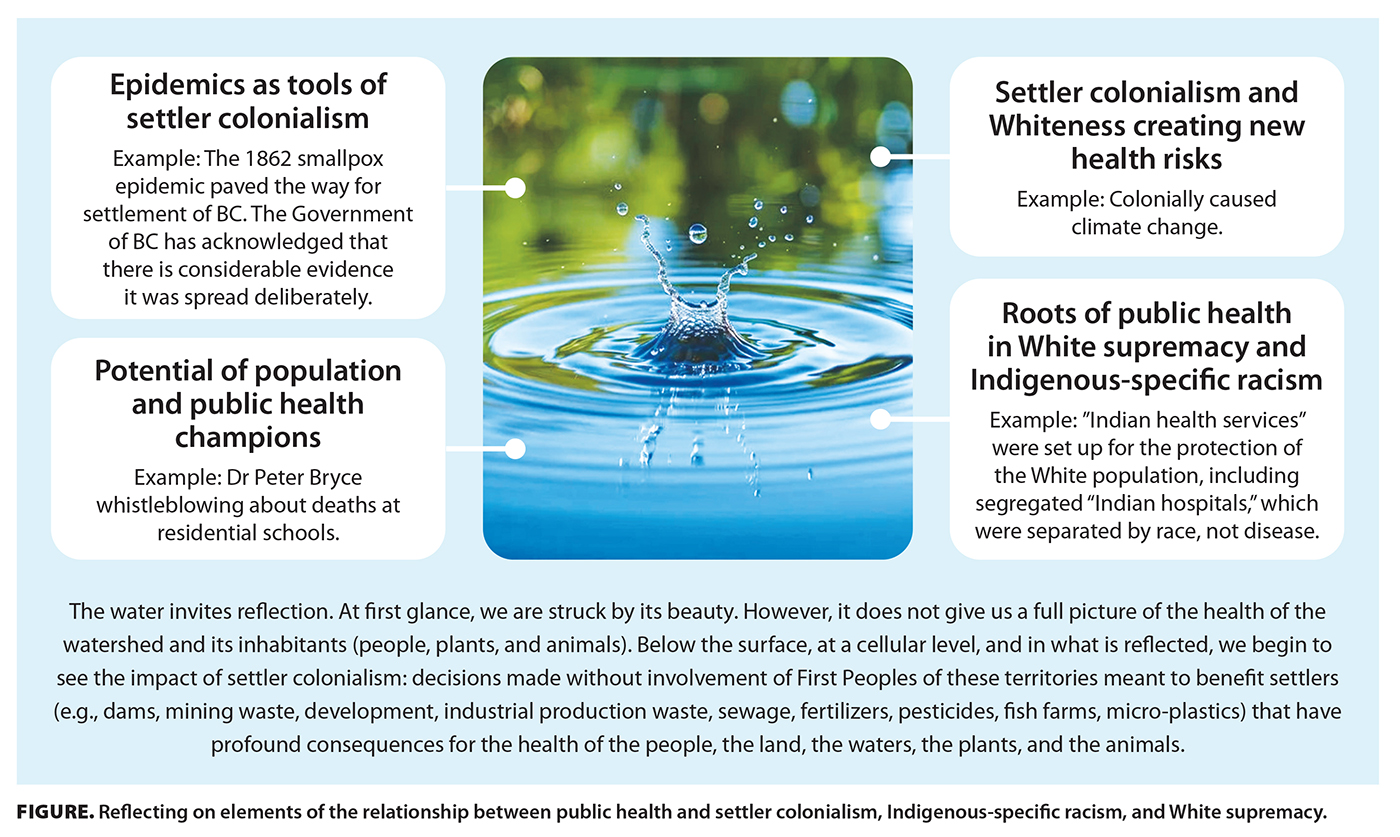
Until we acknowledge the truth, we will be unable to reset relationships with the First Peoples of these territories, as well as with Indigenous Peoples (including First Nations, Inuit, and Métis people from homelands elsewhere in Canada) who now reside in BC. Each has inherent rights to the highest standard of health and health care (UNDRIP Article 24).[10] This must be both an individual and a collective journey to identify and eradicate Indigenous-specific racism and discrimination within all aspects of BC’s population and public health system.
A call to public health
Nearly 10 years since the release of the Truth and Reconciliation Commission’s report, Canadian institutions—including public health systems—have yet to advance the Calls to Action in a demonstrated, transformative, accountable, and sustained way.[11] Instructions provided in this and other reports since represent lifesaving solutions to health care disparities through fully upheld Indigenous rights. The Truth and Reconciliation Commission named UNDRIP as the framework for reconciliation.[6] The ensuing provincial legislation of the Declaration on the Rights of Indigenous Peoples Act led to the Declaration on the Rights of Indigenous Peoples Act Action Plan, which calls for full implementation of the In Plain Sight recommendations.[3] The In Plain Sight recommendations begin by calling for an apology and leadership commitment:
- In Plain Sight recommendation #1: “That the B.C. government apologize for Indigenous-specific racism in the health care system, setting the tone for similar apologies throughout the health system, and affirm its responsibility to direct and implement a comprehensive system-wide approach to addressing the problem, including standardized language and definitions, and clear roles and responsibilities for health authorities, regulatory bodies, associations and unions, and educational institutions.”[8]
Grounded in the principle of truth before reconciliation, an apology and leadership commitment mark initial steps in acknowledging the thee eats (“truths”) already shared by Indigenous Peoples and public health’s responsibilities in relation to them. This includes acknowledging that Indigenous-specific racism and discrimination exist in our population and public health system—it is systemic and structural. If we haven’t done anything about it, then the truth is it’s still there. Working to identify, name, and untie those “settler-colonial knots” that continue to harm Indigenous people is our responsibility.[12]
We see the value in the extremely reasonable request that BC public health institutions and the people within them engage in individual and collective self-reflection about the truths and our participation in harm caused to First Nations, Inuit, and Métis Peoples under the guise of public health since contact. We acknowledge that words without commitments or actions are meaningless.
Jody Wilson-Raybould (Puglaas) of the We Wai Kai First Nation has guided all Canadians to undertake three tasks—to learn, to understand, and to act—to reach “true reconciliation.”[13] Without intervention, Indigenous-specific racism remains intact and active in our systems. What follows will be continual work to recognize, name, and act to untie the “settler-colonial knots” embedded in the structures, policies, practices, norms, and values of our organization until we have successfully eradicated Indigenous-specific racism.[12,14] We accept this as everyday work requiring everyday attention.
—Janene Erickson, Nak'azdli Whut'en, MPH, BKin
Executive Director, Indigenous Health, BCCDC
Adjunct Professor, School of Population and Public Health, UBC
—Isha Gill (Punjabi-Sikh occupier), MPH
Project Manager, Indigenous Health, BCCDC
—Rhonda Buie, Anishinaabe, BSc
Project Coordinator, Indigenous Health, BCCDC
—Sarah Nahinu-Dicks, Sḵwx̱wú7mesh Úxwumixw (Squamish Nation)
Administrative Assistant, Indigenous Health, BCCDC
—Lauren Allard (White occupier)
Project Manager, Central Administration, BCCDC
—Robin Smoker-Peters, Nlaka'pamux from ƛ̓q̓əmci̓n (Lytton First Nation) and settler ancestry, MA
Program Manager, Indigenous Health, PHSA
Adjunct Professor, University of Victoria and University of Western Ontario
—Kate Jongbloed (White occupier), PhD
Senior Scientist, BCCDC
Adjunct Professor, University of Victoria
hidden
This article is the opinion of the BC Centre for Disease Control and has not been peer reviewed by the BCMJ Editorial Board.
References
1. Sparrow D. Know who you are, know where you come from. TEDxLangaraCollege. 10 November 2021. Accessed 20 July 2025. https://youtu.be/a8RqpuE72c0 .
2. Union of BC Indian Chiefs. Stolen lands, broken promises. Accessed 20 July 2025. www.ubcic.bc.ca/stolenlands_brokenpromises .
3. Government of British Columbia. Declaration on the Rights of Indigenous Peoples Act action plan 2022-2027. Accessed 23 July 2025. www2.gov.bc.ca/assets/gov/government/ministries-organizations/ministries/indigenous-relations-reconciliation/declaration_act_action_plan.pdf .
4. Provincial Health Services Authority. Coast Salish teachings with Knowledge Keeper Sulksun. 3 November 2023. Accessed 16 August 2024. https://youtu.be/jICuNqe9Cew .
5. Pointe S (Sulksun). Coast Salish teachings. Accessed 20 July 2025. www.phsa.ca/about/who-we-are/purpose-vision-values-teachings/coast-salish-teachings .
6. Truth and Reconciliation Commission of Canada. Honouring the truth, reconciling for the future: Summary of the final report of the Truth and Reconciliation Commission of Canada. 2015. Accessed 20 July 2025. https://publications.gc.ca/collections/collection_2015/trc/IR4-7-2015-eng.pdf .
7. Hendry J, Behn Smith D, Gallagher J (Kʷunuhmen), et al. Instructions have been provided: Addressing Indigenous-specific racism and implementing foundational obligations to Indigenous Peoples. Int J Indig Health 2025;20. https://doi.org/10.32799/ijih.v20i2.43248 .
8. Turpel-Lafond ME. In plain sight: Addressing Indigenous-specific racism and discrimination in B.C. health care. November 2020. Accessed 20 July 2025. https://engage.gov.bc.ca/app/uploads/sites/613/2020/11/In-Plain-Sight-Summary-Report.pdf .
9. Health Standards Organization. HSO 75000:2022 - British Columbia cultural safety and humility standard. Accessed 20 July 2025. https://healthstandards.org/standard/cultural-safety-and-humility-standard/ .
10. United Nations General Assembly. Resolution adopted by the General Assembly on 13 September 2007: 61/295. United Nations Declaration on the Rights of Indigenous Peoples. Accessed 20 July 2025. https://docs.un.org/en/A/res/61/295 .
11. Jewell E, Mosby I. Calls to Action accountability: A 2023 status update on reconciliation. Yellowhead Institute, 2023. Accessed 20 July 2025. https://yellowheadinstitute.org/wp-content/uploads/2023/12/YI-TRC-C2A-2023-Special-Report-compressed.pdf .
12. Jongbloed K, Hendry J, Behn Smith D, Gallagher J (Kʷunuhmen). Towards untying colonial knots in Canadian health systems: A net metaphor for settler-colonialism. Healthc Manage Forum. 2023;36:228-234. https://doi.org/10.1177/08404704231168843 .
13. Wilson-Raybould J. True reconciliation: How to be a force for change. Toronto: McClelland & Stewart; 2022. ISBN: 978-0-7710-0438-4.
14. Jones CP. Toward the science and practice of anti-racism: Launching a national campaign against racism. Ethn Dis 2018;28(Suppl 1):231-234. https://doi.org/10.18865/ed.28.S1.231 .